YouTube Shorts Size: A Shape, Not a Resolution
Every guide says 1080 x 1920. YouTube says square or vertical, up to three minutes, and never mentions a resolution at all. The difference decides which revenue model your upload lands in.
Every guide ranking for this question gives the same answer: 1080 × 1920, 9:16. YouTube does not say that anywhere.
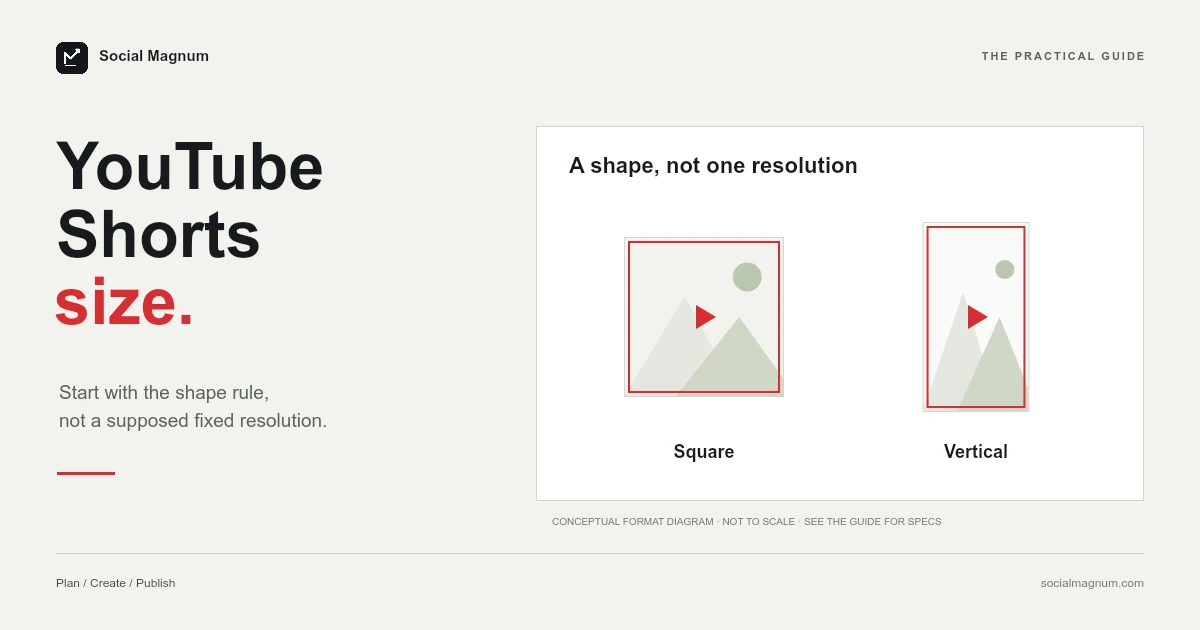
What YouTube actually requires is a shape — square or vertical — and a length. Not a resolution. Which means a perfectly square video is a valid Short, and almost nobody writing about this mentions it.
The requirement, in YouTube’s words
YouTube’s instructions for uploading a Short from a computer list exactly two conditions for the file you select.
| Condition | YouTube's wording |
|---|---|
| Length | Up to 3 minutes. |
| Shape | With a square or vertical aspect ratio. |
| Batch | You can choose up to 15 short videos at a time |
Key facts, read from YouTube Help on 21 August 2026: to upload a Short from a computer the video must be up to 3 minutes long with a square or vertical aspect ratio, and up to 15 Shorts can be selected at once. YouTube publishes no resolution; 1080 × 1920 at 9:16 is the universal convention. Videos uploaded on or after 15 October 2024 that meet the shape-and-length rule are categorised as Shorts automatically, and any Short over one minute with an active copyright claim is blocked globally, while Shorts under one minute see no change. Since 31 March 2025 views count every play; monetisation uses Engaged views.
That is the specification. There is no pixel count, no minimum resolution, and no mention of 1080 × 1920 at all.
So should you still use 1080 × 1920?
Yes, in almost every case — and it is worth being clear that the convention is a good one rather than a mistake.
9:16 fills a phone screen completely, which square does not. 1080 wide is enough resolution for a modern display without producing a file that takes a long time to upload. It matches what Instagram Reels and TikTok use, so one export serves all three.
The reason to know it is convention rather than requirement is narrower but real: it tells you what happens at the edges. If you have square footage, you do not need to letterbox it into a 9:16 frame to qualify. If your camera shot 1440 × 2560, you do not need to downscale to 1080 first. Those are both decisions people make unnecessarily because they believe a specification exists that does not.
Shape and length decide how you get paid
This is the part that turns an aspect ratio into a business decision, and it is the strongest argument for understanding the rule rather than the convention.
YouTube categorises uploads automatically. Any video uploaded on or after 15 October 2024 with a square or vertical aspect ratio, up to three minutes long, is classified as a Short — and is monetised through the Shorts revenue sharing model rather than the long-form one. Official Artist Channels have the same rule from 8 December 2025.
Videos uploaded before those dates keep their original classification, which is why an older vertical video on a channel can sit in the long-form model while a newer identical one does not.
Which means a three-minute vertical video is not a short video that happens to be tall. It is a deliberate election into a different monetisation model, made at the moment you export.
Sixty seconds still matters, for a different reason
The three-minute limit is reported as unambiguously good news. There is a condition attached to it that we did not find on a single page ranking for this term.
YouTube states that any Short over one minute long with an active copyright claim of any type, including manual claims, will be blocked globally. Not demonetised — blocked. The video will not be playable, will not be recommended, and is not eligible for monetisation.
For Shorts under one minute, YouTube says there is no change in limitations. So the sixty-second mark has not disappeared; it has changed from a length limit into a copyright threshold.
If you are going past a minute, the safe path is audio you are certain of — original, or licensed to you, or from YouTube’s own tools. The three extra minutes are only useful if the video stays online.
The view count is not the number that pays
One more change worth knowing, because it makes Shorts analytics read strangely if you do not.
Since 31 March 2025, YouTube counts a Shorts view every time the video starts to play or replay, with no minimum watch time. The stricter metric still exists and is now called Engaged views, which counts viewers who chose to keep watching.
The distinction matters because YouTube says Partner Programme eligibility and Shorts ad revenue sharing are both based on Engaged views. So the large number on the video is a reach figure, and the smaller one underneath it is the number connected to money.
A Short whose views climb while its engaged views stay flat is being started and abandoned, which is a content signal rather than a distribution one — and it is invisible if you only read the headline count.
What covers the frame
Shorts are watched in an interface that sits on top of the video: a title, the channel name, the description, a row of buttons down the right edge, and the sound attribution along the bottom.
YouTube does not publish safe-area figures, so anyone quoting exact pixels is measuring rather than citing. The working rule that survives every version of the interface is the one that applies across every vertical format: keep whatever must be read inside the middle portion of the frame, and treat the bottom strip and the right edge as occupied.
This is the same constraint we found writing about Instagram Story sizes, where the safe area is also a community measurement rather than a published figure.
The other figures in circulation
Once you know YouTube publishes a shape rather than a size, the other numbers people quote become easier to place.
One page-one guide gives a dimension range of 240 × 426 up to 4320 × 7680, and a maximum file size of 60 MB. Neither figure appears in YouTube’s upload documentation, which states only the length and the shape.
They are not unreasonable numbers — the upper bound is 8K vertical and the lower is roughly the smallest thing worth watching — but they belong in the convention column rather than the documented one. The distinction matters when something changes, because a documented figure can be re-read and a convention cannot.
The one genuinely useful practical figure YouTube does give is unrelated to size: you can select up to fifteen short videos at a time when uploading through Studio. If you batch your production, that is the number that shapes your workflow.
The thumbnail is the exception: YouTube does publish a size for it, covered in YouTube thumbnail size. TikTok uses the same 9:16 frame with a length limit that varies per account, see TikTok video size.
What the internet still gets wrong here
- “Maximum length is 60 seconds.” A page ranking on the first page of Google still says this. It has been three minutes for standard channels since October 2024.
- “The required size is 1080 × 1920.” It is the sensible default and it is not a requirement. YouTube asks for a square or vertical shape.
- Silence about the copyright cliff. The one-minute threshold for claimed content is the single most consequential rule here and it is absent from the results we read.
None of which is surprising once you notice that no official YouTube page appears in the top eight organic results for this query. The answers circulating are copies of copies, and the oldest of them predate the change they are describing.
Getting existing footage into the frame
Most Shorts start life as something else — a clip from a longer video, or footage shot horizontally before anyone thought about vertical.
Going from 16:9 to 9:16 discards the majority of the width, so the only real decision is which part of the frame to keep. A centre crop is right for a single subject in the middle and wrong for almost everything else, including two people talking.
Our free video editor runs in the browser with no upload and no account, and our guide to social media image sizes marks which figures across every platform are documented and which — like 1080 × 1920 here — are only widely agreed.
The short version
- 1
YouTube publishes no Shorts resolution — it requires a square or vertical shape
- 2
A 1:1 square video is a valid Short, which no page-one result mentions
- 3
Shape and length automatically decide which revenue-sharing model applies
- 4
Over one minute, any copyright claim blocks the Short globally; under one, no change
- 5
Monetisation uses Engaged views, not the headline view count