Best Time to Post on TikTok: Seven Million Posts, Two Opposite Answers
Buffer's seven-million-post dataset says Sunday morning. Sprout says weekday afternoon. Both are real averages — and on a feed built for non-followers, timing matters less here anyway.
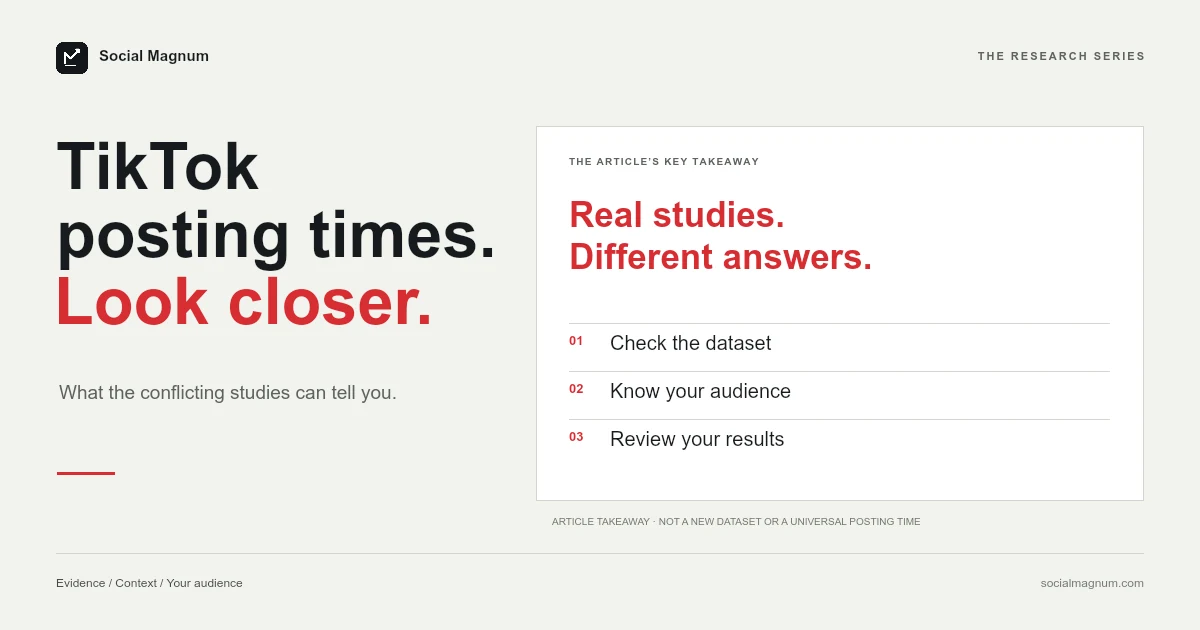
Buffer analysed seven million TikTok posts and concluded the best time is Sunday at 9am. Sprout Social analysed its own data and concluded Tuesday to Thursday, between 2pm and 6pm.
Those are not adjacent answers. One is a weekend morning and the other is a weekday afternoon, and both are drawn from large datasets by serious companies. That contradiction is the most useful thing on this page, because it tells you what a bigger sample does and does not fix.
There is no universal best time to post on TikTok. What decides it is where your viewers are and when they are active, which TikTok Analytics shows per account, and on a feed built to serve non-followers the hour matters less than it does on Instagram.
What page one actually says
| Source | Its answer |
|---|---|
| Buffer (7 million posts) | Sunday 9am, then Monday 1pm, then Sunday 1pm |
| Sprout Social | Tuesday to Thursday, 2–6pm local time |
| Forbes | Wednesday 4pm |
| Adobe | 6pm is most popular; the best time is 8am; Saturday |
| Small Business Expo | Sunday 8–9am |
A larger sample makes an average more precise. It does not make it more relevant to you. Seven million posts from Buffer’s dataset produce an accurate description of Buffer’s customers — and if your account does not resemble that population, the precision is not doing you any good.
Put the numbers side by side and the spread is the finding.
| Recommendation | Day | Hour |
|---|---|---|
| Buffer | Sunday | 9am |
| Small Business Expo | Sunday | 8–9am |
| Adobe | Saturday | 8am |
| Forbes | Wednesday | 4pm |
| Sprout Social | Tuesday–Thursday | 2–6pm |
Three of the five land on a weekend before 9am. Two land midweek after 2pm. There is no hour that is a compromise between those positions, which means at least one group is confidently wrong about any given account — including yours.
Adobe’s entry shows the strain most clearly: it reports 6pm as the most popular posting time and 8am as the best one, in the same breath. Those are both real findings, and together they say that when people post and when posts do well are different questions.
Why TikTok is not like the others
There is a reason to treat timing advice more sceptically here than on Instagram or Facebook, and it is structural rather than statistical.
TikTok’s main surface is the For You feed, which is built to show people content from accounts they do not follow. That is the whole design of the product. A post is not primarily competing for the attention of your existing followers at the moment you publish; it is being offered to strangers over a longer period.
It also explains something people notice and find confusing: TikToks sometimes pick up days or weeks after posting. A post that is still being distributed a week later was never going to live or die by the hour it went out.
So does timing matter on TikTok?
The most-upvoted thread on this search asks exactly that, and the honest answer is: less than on other platforms, and not nothing.
It still matters for the first hour. Early engagement is genuinely useful, and being present to reply to the first comments is worth more than the clock position that generated them. It matters for anything time-bound. And it matters for consistency, which is a different mechanism from timing but gets bundled with it.
What it does not appear to be is the lever that separates a video with two thousand views from one with two hundred thousand. That difference lives in the first three seconds of the video, not in the timestamp.
Where does TikTok show when my followers are active?
TikTok Analytics includes a follower activity view showing when the people who follow you are most active, by hour and by day. You need a Business or Creator account to see it.
- Open your profile and go to TikTok Studio or Analytics.
- Find the Followers tab.
- Look at follower activity by hour and by day.
Creators on this page’s results suggest posting 30 to 45 minutes before that peak rather than at it, so the video already exists when people open the app; treat it as a technique to test, not a rule.
Use it, with the caveat above firmly in mind: on TikTok this describes a smaller share of your likely viewers than the equivalent screen does on Instagram. It is still better than a chart built from somebody else’s customers. If you do queue a post into that window, note that TikTok’s own scheduler allows ten days and no edits, which we covered in scheduling TikTok posts.
What if you have no followers yet?
The advice to check your own analytics assumes you have some, which is useless if you started last week. New accounts are exactly the ones searching this question, and every chart-based article quietly ignores them.
With no followers to measure, the honest answer is that timing is not your variable. A brand new account is almost entirely dependent on the For You feed, where the publishing hour has the least influence of anywhere on the platform.
What to do instead: post at a time you can reliably repeat, be there for the first hour, and accumulate enough posts that you have data of your own. Thirty posts at a consistent hour will teach you more about your audience than any chart, and you will have built the analytics you were missing while you were at it.
Frequency does more than timing
If you are going to spend effort on something adjacent to timing, spend it here.
A recommendation feed works in attempts. Each post is a fresh chance to be shown to people who do not follow you, and the outcomes vary enormously between posts by the same account. Two posts a day is twice as many chances as one, and that is a larger effect than moving either post by three hours.
This is also why the timing question absorbs so much attention while producing so little. Choosing an hour feels like optimisation and costs nothing. Doubling output is genuinely optimisation and costs a great deal — so the cheap lever gets discussed and the expensive one gets avoided.
Your audience is probably not where you are
TikTok distributes across borders more readily than a follower-based feed does, which creates a problem the published charts never address: a recommended local time assumes your viewers are local.
Plenty of accounts find their audience is somewhere else entirely — a British creator with a mostly American following, an Indonesian account picked up in the Philippines. When that happens, posting at the peak hour for your own country is actively wrong, and no amount of precision in the chart fixes it.
Your analytics will show you follower locations alongside activity, and it is worth looking at that first. If the top territory is not the one you live in, that single fact matters more than every recommendation on this page.
Testing it properly
If you want a real answer for your account rather than a borrowed one, the method is the same on every platform and it is not complicated.
- Pick two windows that are genuinely different — a morning and an evening.
- Alternate between them for several weeks.
- Compare like with like. A trending-sound video against an original-audio one tells you nothing about timing.
- Wait longer than feels necessary before judging. TikTok distributes over days, so a twenty-four-hour verdict on a video is premature.
That last point is TikTok-specific and it is the one people get wrong. Comparing two posts after a day, on a platform that routinely keeps distributing for a week, measures the speed of the start rather than the size of the result.
What actually moves a TikTok
Worth saying plainly, since this page is about a lever that is mostly not the answer.
The opening seconds do more than anything else — whether someone keeps watching rather than scrolling past. So does watch time relative to length, which is why a tight thirty seconds often outperforms a loose two minutes. So does posting often enough to get more attempts.
Timing is worth setting sensibly and then not thinking about again. If you find yourself reading a fourth article about it, the marginal return has already gone.
A useful test for any advice on this subject, including ours: does following it change what you make, or only when you upload it? Advice that only moves the clock is cheap to give and cheap to follow, which is roughly what it is worth.
The short version
- 1
Buffer's 7-million-post dataset says Sunday morning; Sprout says weekday afternoon
- 2
A bigger sample makes an average more precise, not more relevant to your account
- 3
TikTok distributes largely to non-followers, so follower-activity timing matters less here
- 4
Judge a TikTok over days, not hours — it is still being distributed after the first day