Facebook Already Tells You When to Post
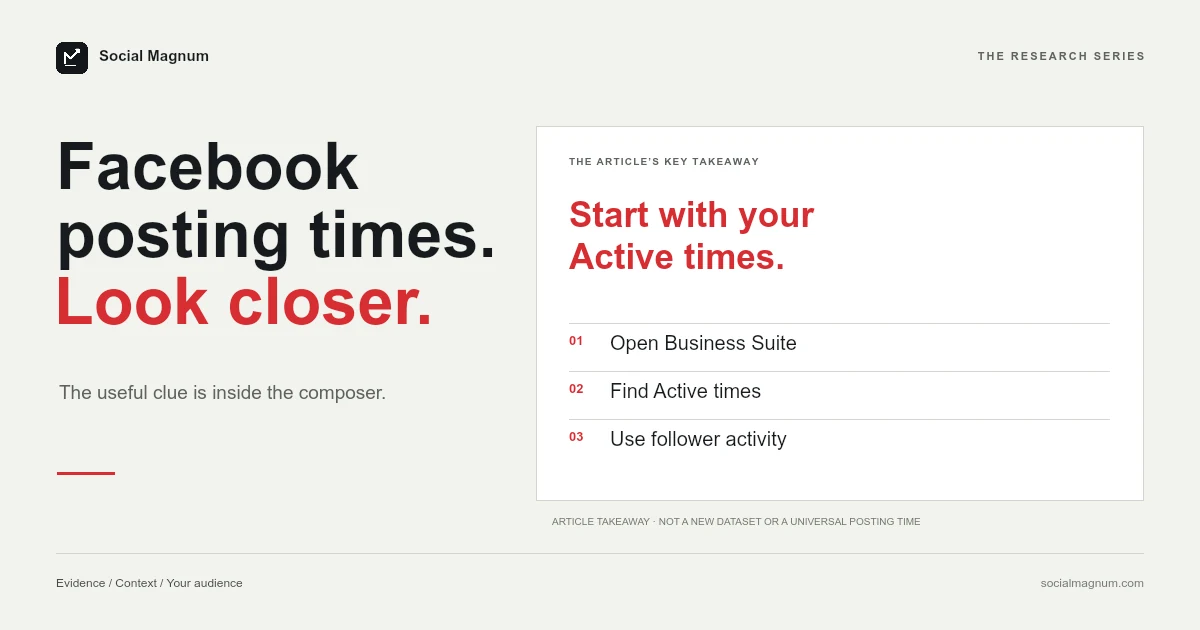
Six guides rank for this question and give six answers. Facebook has an Active times control inside its own composer, built from your followers, and almost nobody writing about this mentions it.
Six guides currently rank for this question and they give six different answers. Meanwhile Facebook has a button in its own composer that tells you when your followers are online, and almost nobody writing about this mentions it.
It is free, it is two clicks from where you already are, and it is built from your audience rather than somebody else’s customers.
What page one actually says
| Source | Its answer |
|---|---|
| Buffer (14 million posts) | Thursday 9am; Wednesday and Sunday mornings |
| Shopify | Thursday 9am, citing Buffer |
| Sprout Social | Tuesday and Wednesday, 12–8pm |
| SocialPilot (50,000+ accounts) | 9am–3pm weekdays, 10am–6pm weekends |
| Ignite Visibility | Wednesday 11am and 1pm; 9am Monday–Friday |
| Elementor | 8–11am weekdays, and 6–9pm evenings |
SocialPilot’s answer is the most revealing of the set. Nine in the morning until three in the afternoon on weekdays, ten until six at weekends: that is not a recommendation, it is a description of when people are awake and not at their busiest. It is almost certainly accurate and it cannot help you choose anything.
Facebook already tells you
Open Meta Business Suite, start a post, and look at the Scheduling options. Next to the date and time controls there is an Active times link.
Those recommendations are generated from when the people who follow your Page are actually using Facebook. Not an average of Buffer’s customers, not an average of Sprout’s — yours.
It is worth pausing on how strange the situation is. The most-linked answer to this question is a chart derived from millions of strangers, while the actual answer sits inside the publishing tool, unmentioned, on the same screen where you would act on it.
We came across it while documenting how Facebook scheduling works, and it is comfortably the most useful thing on that screen.
Where is Active times in Meta Business Suite?
- Go to your Page and open Meta Business Suite.
- Click Create post.
- Next to Scheduling options, click the Set date and time toggle.
- Click Active times.
You need a Page rather than a personal profile, and enough followers for the data to mean anything. A Page with forty followers will produce a noisy chart, which is a limitation of arithmetic rather than of the tool. Below a few hundred followers, treat whatever it shows as a suggestion rather than a signal, and look again once the audience has grown enough for the pattern to be stable.
Why do Facebook posting-time studies disagree?
Understanding the mechanism is what stops you chasing the next chart.
- Different customer bases. Buffer’s fourteen million posts come from Buffer’s users. A different tool has different users and gets a different answer.
- Different industries. A restaurant Page and a software Page have audiences awake at different hours, and an average across both describes neither.
- Different definitions of best. Most engagement, most reach and most clicks do not peak at the same time, and guides rarely say which they measured.
None of that makes any individual study wrong. It makes all of them irrelevant to a specific Page, which is the only kind of Page anyone actually runs. We set the general mechanism out once in why best-time-to-post charts disagree.
What Active times will not tell you
Since we have just spent the article recommending it, the limits deserve stating.
It measures your existing followers. It says nothing about people who might encounter your Page without following it, and on a platform where sharing moves content between audiences, that is a real omission.
It is also self-reinforcing in the same way Instagram’s equivalent is. The followers you have are the ones your existing schedule suited, so the data describes the audience your habits produced rather than the one available to you.
The bigger Facebook problem is not timing
Worth saying directly, because it reframes the whole question on this platform in particular.
Organic reach for Facebook Pages is low. A Page post is shown to a modest fraction of the people who follow it, and that fraction is decided by factors far removed from the hour it went out. Optimising the timestamp while reach is the constraint is a small adjustment to a small number.
The levers that actually move Facebook reach are the ones nobody wants to hear: content people respond to rather than scroll past, formats Facebook is currently distributing well, and — for many Pages — paid distribution, which is the honest answer for a platform that monetises reach.
Timing still helps at the margin, and the margin is where it lives. Get it roughly right with Active times and put the remaining effort somewhere with more leverage.
This is also why Facebook advice ages worse than advice about other platforms. Reach conditions for Pages have shifted repeatedly over the years, so a study from two years ago may describe a version of the feed that no longer exists — while an Active times reading taken this morning describes the one you are actually posting into.
If you take one thing from this page, take that. A recent measurement of your own audience beats an old measurement of everybody else’s, and the recent measurement of your own audience is free and already open in another tab.
Groups are a different question entirely
Almost everything written about Facebook timing is about Pages, and Groups behave differently enough that the advice does not transfer.
A Group post reaches people who joined specifically to see that subject, which is a fundamentally warmer audience than a Page’s followers. Members are there on purpose, notifications behave differently, and the discussion often continues for days rather than peaking in an hour.
The practical consequence is that timing matters even less in a Group, and rhythm matters more. A weekly thread that always appears on the same morning trains people to look for it, and that habit is worth more than any individual well-chosen slot. If you run a Group, the recurring-post scheduling we covered in the Facebook scheduling guide exists for exactly this and does not exist for Pages.
Reels and Stories are not the feed
Facebook is several products sharing a logo, and the timing logic differs between them.
A Story expires, so its window is genuinely short and posting when your audience is around matters more than it does for anything else on the platform. A Reel sits on a recommendation surface much like TikTok’s, where distribution continues past the first day and the publishing hour matters less.
Active times measures follower activity, which maps well onto Stories, reasonably onto feed posts, and least well onto Reels. Using one number for all three is the most common way this data gets misapplied.
How often, not just when
The question next to this one is usually more valuable and gets asked far less.
Posting more often gives you more chances to be seen, which on a platform with constrained organic reach matters more than moving any single post. It also produces the data you need: an account posting twice a week takes months to learn anything about its own timing, while one posting daily has an answer within weeks.
There is a ceiling, and it is set by whether you can sustain the quality rather than by any published limit. Two good posts a week beats five thin ones, and the failure mode of frequency advice is people meeting the number by lowering the bar.
If you want to test it anyway
- Take two windows from Active times that are genuinely different.
- Alternate for several weeks, keeping post type steady.
- Compare like with like — a link post against a link post, not against a video.
- Decide in advance what you are measuring. Reach and engagement are different questions and will give you different winners.
That last point is the one the published studies gloss over, and it is why two honest analyses can disagree without either being wrong.
Give it long enough to mean something, too. Facebook Pages typically post less often than Instagram or TikTok accounts, so accumulating a comparable number of posts in each window takes longer here. Six posts a side is a hint; twenty is a finding.
And write the result down when you get one. The single most common outcome of these tests is that nobody records the conclusion, the question resurfaces four months later, and somebody starts reading charts again.
The short version
- 1
Facebook's composer has an Active times control built from your own followers
- 2
Buffer's 14-million-post study says Thursday morning; Sprout says Tuesday afternoon
- 3
Active times only measures existing followers, and reflects the schedule you already keep
- 4
On Facebook Pages, organic reach constrains results far more than the posting hour does