The Best Time to Post on Pinterest Is a Season, Not an Hour
One guide ranking for this question recommends 2am to 4am. Understanding why that figure exists explains the entire genre — and Pinterest is a search engine where the hour barely matters anyway.
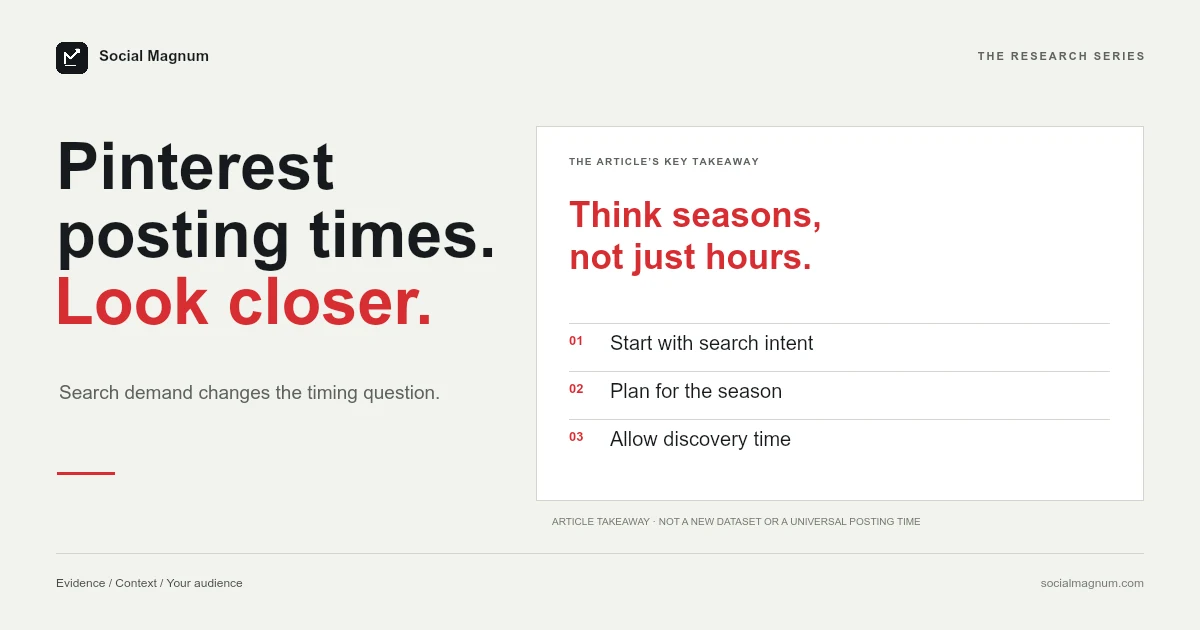
One of the guides ranking for this question recommends posting to Pinterest between 2am and 4am.
That is not a typo and it is not stupidity. It is what happens when you average engagement by hour without accounting for how few people post at three in the morning — and it explains the whole genre more clearly than any of the sensible-looking recommendations do. There is no best hour to pin; what decides a pin’s reach is search, so the timing decision that matters is how far ahead of a season you publish.
What page one actually says
| Source | Its answer |
|---|---|
| QuickFrame | Monday 8pm, then Tuesday 4pm |
| PinGenerator | 8–11pm, and also 2am–4am; Fridays |
| RecurPost | Afternoon and evening; weekend evenings strongest |
| Facebook community post | 9am–12pm |
Once you have seen that, you cannot unsee it in the rest of the table. Every hourly engagement average is shaped by how many posts were competing in that hour, and the quiet hours are always the ones most likely to throw up a flattering figure from a handful of posts.
This is not an argument that any of these companies are careless. It is an argument that “average engagement per post, by hour” is a fragile measurement, and that fragility is visible here because 2am is obviously absurd. On the hours that are not obviously absurd, the same fragility is invisible.
Pinterest is a search engine wearing a feed’s clothes
The deeper reason to disregard hourly advice here is structural, and it makes Pinterest the least timing-sensitive platform in this whole cluster.
People arrive at Pinterest to look for something — a recipe, a haircut, a kitchen, a wedding. Pins surface through search and related-pin recommendations, and they keep surfacing. A pin published today can be found next spring by someone typing the same query, and for many accounts the traffic a pin earns in its first week is a small fraction of what it earns in its first year.
We made a similar point about YouTube, which also earns views long after publication. Pinterest takes it further, because there is barely a real-time feed to compete in at all. The averaging problem itself is set out in why best-time-to-post charts disagree.
How far ahead should seasonal pins go out?
There is a genuine, high-leverage timing decision on Pinterest, and it has nothing to do with the hour of the day.
Pinterest is where people plan. Someone searching for Christmas table settings is not doing it on Christmas Eve — they are doing it weeks or months earlier, while there is still time to act on what they find. The same is true of weddings, holidays, back-to-school, spring cleaning and every other seasonal moment the platform runs on.
Which means content published the week of an event has largely missed it. Seasonal material wants to exist well before the season, so it has time to be indexed, surfaced and saved by the people doing the planning.
Getting that lead time roughly right is worth more than every hourly recommendation on this page combined. It is also the one piece of timing advice on Pinterest that is genuinely specific to the platform rather than borrowed from social feeds.
Working out your own lead time
Since seasonal timing is the decision that actually matters here, it is worth having a method rather than a guess.
- Ask when the decision gets made, not when the event happens. Someone buying a Halloween costume decides in September. Someone planning a wedding decides a year out. The gap between decision and event is your lead time.
- Then add time to be found. A pin does not surface the moment it exists; it needs to be indexed and start earning saves. Publishing exactly at the start of the planning window is already slightly late.
- Check last year in your own analytics. If you posted seasonal content before, you can see when it actually started earning impressions rather than when you hoped it would.
That last step is the one that turns this from a rule of thumb into something specific to your account, and it costs about ten minutes once a year.
Most pins should not be seasonal at all
The flip side of a platform with a long memory is that undated content compounds in a way it cannot on a feed.
A pin about how to fix a wobbly table is as useful in March as in November, and it will keep being found for as long as people keep having wobbly tables. A pin about a specific sale that ended is dead the moment the sale does, and it will still be occupying a slot in your boards.
For most accounts the right balance is a majority of evergreen material with seasonal content layered on ahead of the relevant moment. That is close to the opposite of how people treat feed platforms, where the newest thing is the only thing that matters, and it is the single biggest adjustment for anyone arriving here from Instagram.
What does Pinterest Analytics actually tell you?
Pinterest Analytics, available with a business account, shows how your pins perform over time and which of them are still earning impressions long after publication.
That second thing is the more useful view, and it is not the one people go looking for. The question worth asking of your own data is not “which hour performs best” but “which pins are still working months later, and what do they have in common”. That is where Pinterest’s compounding actually shows up.
Sorting by impressions over the longest window available is usually enough to see it. The pins at the top will rarely be your most recent, and the pattern in what they cover is a better brief for what to make next than any posting schedule could be. On a platform with a long memory, your own back catalogue is the most honest research you have access to.
Consistency, not the clock
The advice that survives contact with how Pinterest works is unglamorous.
Pinning regularly matters more than pinning at a particular moment, because every pin is another entry in a search index that keeps working. Ten pins spread across a fortnight will almost always outperform ten pins published in one carefully chosen hour, simply because they represent ten independent chances to be found.
Spacing also protects you from a failure mode specific to this platform: dumping a large batch at once produces a spike of activity from one account and nothing for days afterwards, which is neither how the platform is designed to be used nor how a person browsing it behaves.
This is the one place where a scheduling tool earns its keep on Pinterest, and it is not for the reason people expect. The value is not hitting a magic hour — it is being able to prepare a season’s worth of pins in a single working session and have them released gradually over the following weeks, rather than either posting them all at once or remembering to do it by hand every day.
That reframes the whole tool question. On a feed platform, scheduling buys you precision. On Pinterest it buys you patience, which is the harder thing to supply manually and the more useful of the two here.
What actually decides a pin
- The image. Pinterest is visual search, and a vertical, legible, well-composed image is the entire click decision.
- The text on and around it. Titles, descriptions and the words in the image are what makes a pin findable, because searching is how people arrive.
- Whether it is worth saving. A save is a stronger signal than a click and a longer-lived one, and it is earned by usefulness rather than by timing.
If you are choosing between spending an hour on the pin image and an hour on the posting schedule, the image wins by a distance that is not close.
Which is, in the end, the same conclusion as everywhere else in this cluster — just more starkly true here, on a platform where the thing you published today is still working next year.
The short version
- 1
One ranking guide recommends 2am–4am, which is a small-sample artefact rather than advice
- 2
Pinterest is a search engine; pins keep earning traffic for months or years
- 3
The real timing decision is seasonal lead time, not the hour of day
- 4
Pin regularly rather than in batches — every pin is another entry in a search index