Best Time to Post on LinkedIn: Ten Hours of Disagreement
LinkedIn ranks twice on page one for this question and its two answers contradict each other. The largest study on the page, 4.8 million posts, disagrees with the consensus as well.
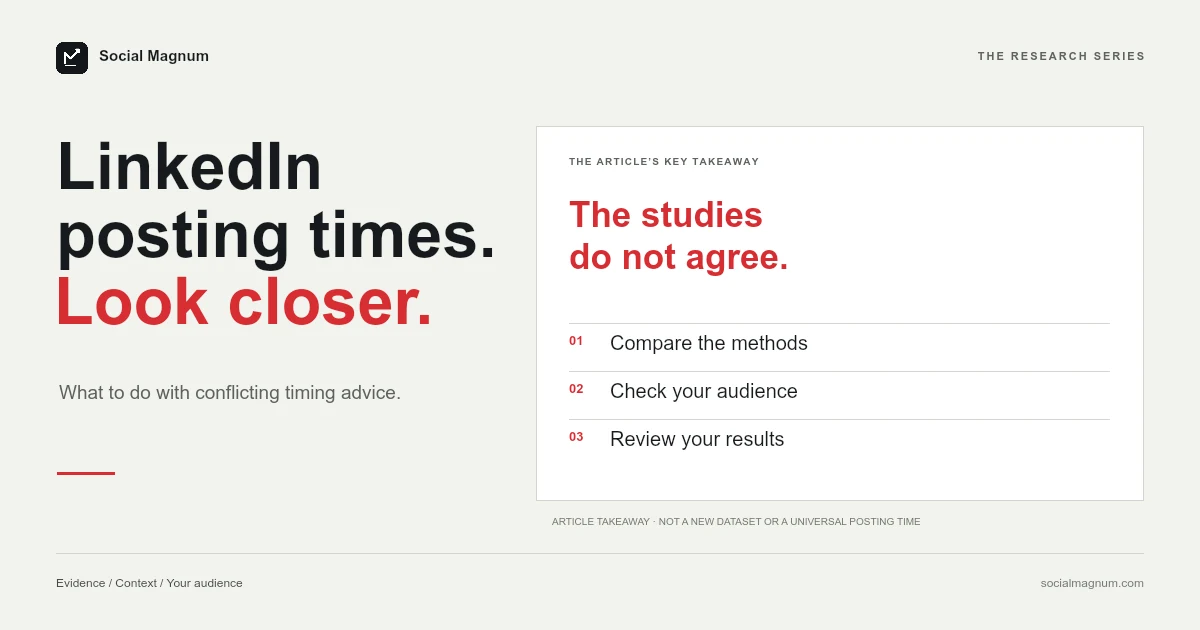
LinkedIn ranks twice on the first page of Google for this question, and its two answers disagree with each other.
Its own marketing blog recommends mid-morning. An article published on LinkedIn by a LinkedIn user says the strongest slots are now late afternoon. Both are on linkedin.com, both are currently on page one, and they are describing different halves of the working day. There is no single best hour; what every source does agree on is weekdays, Tuesday to Thursday, and what decides the hour for you is where your audience sits, which your Page analytics show by location.
What page one actually says
| Source | Its answer |
|---|---|
| LinkedIn’s business blog | 10–11am and 12–1pm, Tuesday to Thursday |
| Sprout Social | Tuesday 11am–5pm, Wednesday 11am–4pm, Thursday 1–5pm |
| Buffer | 3pm–8pm on weekdays |
| Sprinklr | Tuesday to Thursday, 10–11am or 1–2pm |
| Supergrow | Tuesday to Thursday, 10am to noon |
| A post on LinkedIn itself | Wednesday 4pm and Friday 3–4pm; peak 3–8pm |
| Capsule CRM | 10am–1pm, Tuesday to Thursday |
The recommendations span from 10 in the morning to 8 in the evening. That is not a disagreement about a detail; it is most of a working day, presented seven times as though it were a specific answer.
The platform contradicting itself
The two LinkedIn results are worth separating, because they are not equivalent and it would be unfair to treat them as such.
The first is LinkedIn’s own marketing blog — the company speaking in its own voice, recommending mid-morning on Tuesday, Wednesday and Thursday. The second is a Pulse article written by an individual and published on LinkedIn’s platform, arguing that the strongest slots have moved to Wednesday at 4pm and Friday between 3 and 4pm.
The largest study disagrees with everyone
Buffer’s guide states that it analysed 4.8 million posts, which is comfortably the largest sample anyone on page one claims.
Its conclusion is late afternoon and evening, between 3pm and 8pm on weekdays. Almost everyone else — including LinkedIn’s own blog — points at mid-morning.
So the biggest dataset on the page produces the answer that most contradicts the consensus. That is worth sitting with rather than resolving, because the usual instinct is to trust the larger sample, and the larger sample here is the outlier.
A likelier explanation than anyone being wrong is that these studies are measuring different populations. A dataset drawn from one tool’s customers reflects those customers’ audiences, industries and countries. Change the population and the peak moves.
What an hourly average is actually made of
Every figure in that table is the same kind of calculation: take a large number of posts, group them by the hour they went out, and compare average engagement.
The problem is that the hour is not the only thing that differs between those groups. Posts published at 8pm are not a random sample of posts published at 10am — they come from different people, in different industries and time zones, writing at different lengths for different reasons.
The hour is doing far less of the work than the presentation implies, and the fragility shows up as exactly the pattern in that table: same method, similar-sounding datasets, answers ten hours apart. The same mechanism, set out once: why best-time-to-post charts disagree.
The time-zone problem is worse on LinkedIn
This is the LinkedIn-specific reason to treat a single clock time with more scepticism here than on a consumer platform.
Almost all of this advice arrives without a time zone attached, or with a vague note to use your audience’s local time. On a platform where audiences are national and social, that is a mild inconvenience. On LinkedIn, where a B2B audience routinely spans several countries, it is the whole question.
Which is not an argument for despair. It is an argument for reading your own analytics, where the audience being measured is the only one that matters — yours.
What is the best day to post on LinkedIn?
Underneath the disagreement, page one is unanimous about something more useful than the hour: weekdays beat weekends, and midweek beats Monday and Friday.
That consensus is worth more than the precision above it, because it follows from something structural rather than statistical. LinkedIn is used substantially during working hours, for work reasons, and Tuesday to Thursday is when most people are neither clearing a backlog nor winding down.
So the defensible version of the advice is: post on a weekday, ideally midweek, at a time your audience is likely to be working. Everything more specific than that is where the sources stop agreeing.
A LinkedIn post lives longer than a tweet
There is a structural reason the hour matters less here than on a faster platform, and it rarely comes up in these guides.
The LinkedIn feed does not move at the pace of X or a Stories tray. People check it a few times a day rather than continuously, often between other things, and a post can surface for someone hours after it went out because it is still what their network was engaging with.
That widens the window considerably. If a post can be encountered across most of a working day rather than in the twenty minutes after publication, then the difference between 10am and 1pm is compressed into something much smaller than a chart comparing those two hours would suggest.
Where your own answer lives
LinkedIn provides the data that settles this for your account specifically, and it does not require a paid tool.
- For a personal profile, the analytics on your own posts show impressions and engagement per post, so you can compare what you published and when.
- For a Company Page, the visitor and follower analytics are more detailed, and include a breakdown of your followers by location and function.
That follower-location breakdown is the single most useful thing on this page. It answers the time-zone question directly, and it is specific to you in a way no published chart can be.
The question worth asking of your own numbers is not which hour wins — at ordinary posting volumes that is noise — but where your audience actually is, and whether the time you post falls inside their working day at all.
What moves the number more than the clock
The advice that survives contact with all seven contradictory recommendations is unglamorous.
Posting regularly matters more than posting at a particular moment, because a schedule you keep produces more posts than a schedule you abandon, and every post is another chance to be seen. Ten posts spread across a month will nearly always outperform ten posts squeezed into one carefully chosen week.
This is also the honest case for a scheduling tool, and it is a smaller claim than the ones usually made. Scheduling does not find you a magic hour. It removes the reason most people stop posting, which is having to be present at the right moment on a day when something else happened. Social Magnum schedules LinkedIn Company Page posts from the same calendar as 20+ other networks, so the slot you pick from this page is the slot the post actually goes out.
We covered the mechanics separately in our guide to scheduling LinkedIn posts, including what LinkedIn does natively for free.
What actually decides a LinkedIn post
- The first two lines. The feed truncates, so the visible opening decides whether anything below it is read at all.
- Whether it is worth a reply. Comments carry further than reactions, and they are earned by saying something specific enough to respond to.
- Whether it is for someone. A post written for everyone in your network is generally read closely by nobody in it.
If you are choosing between an hour spent on the opening line and an hour spent choosing a posting time, the opening line wins by a distance that is not close — which is the same conclusion we reached across the rest of this series, and here the evidence for it is a platform disagreeing with itself in public.
The short version
- 1
LinkedIn.com ranks twice for this query with contradictory answers
- 2
Page one spans 10am to 8pm, which is most of a working day
- 3
The largest dataset on the page, 4.8 million posts, contradicts the consensus
- 4
Weekday and midweek is the only claim everyone agrees on, and it is structural
- 5
Your Page analytics break followers down by location, which settles the time zone