The Best Time to Post on Threads Is Suspiciously Familiar
One company's blog says Thursday 9am while its own Threads post says Wednesday 7am. The same company reports that four different platforms peak at exactly the same hour.
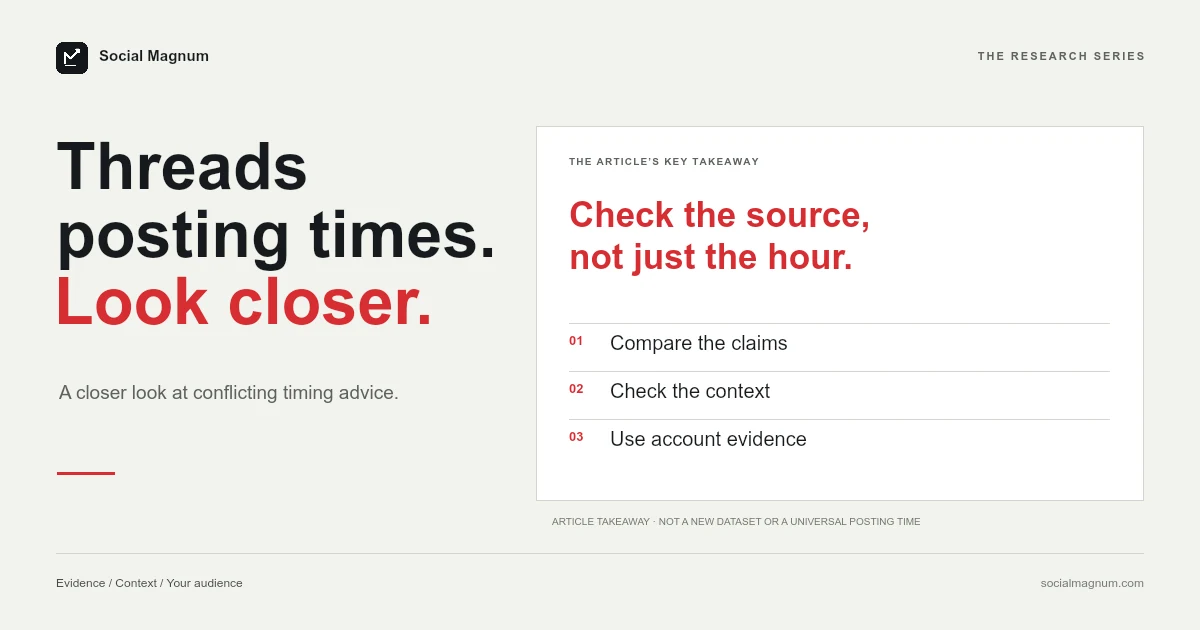
Buffer’s analysis of 2.5 million posts says the best time to post on Threads is Thursday at 9am. Buffer’s own account, posting on Threads, says Wednesday at 7am is the single highest-engagement window.
And a third Buffer post makes a claim more revealing than either: that the best time to post on Instagram, Facebook, Threads and X is exactly the same. That is the most useful sentence written about this subject, though not for the reason it was intended.
There is no universal best time to post on Threads. What decides it is when your own followers are active, which Threads insights and your Instagram audience data show, and on a reply-driven feed, whether you are around afterwards.
What page one actually says
| Source | Its answer |
|---|---|
| Buffer blog (2.5M posts) | Thursday 9am; then Wednesday 12pm and 9am |
| Buffer, posting on Threads | Wednesday 7am, the single highest window |
| Buffer, on Instagram | Wednesday and Thursday; evenings 6–11pm are worst |
| Postpone | Wednesday, Tuesday, Saturday, 1–3pm |
| ElvenFlow (22,799 posts) | Early afternoon, peaking around 2pm ET |
Set aside the competitors for a moment. Three of those five rows are the same company, and they do not agree with each other.
When one source disagrees with itself
Buffer’s blog puts the peak on Thursday morning. Buffer’s post on Threads puts it on Wednesday at 7am.
Which is the point worth taking from it. If a figure derived from 2.5 million posts can shift from Thursday 9am to Wednesday 7am inside two weeks, it is not a stable property of the platform. It is a reading taken at a moment, and the moment has passed by the time you read about it.
The same answer on four different platforms
The stronger observation is in a third Buffer post, and it is stated as a headline finding rather than a caveat: the best time to post on Instagram, Facebook, Threads and X is exactly the same.
There is a simpler explanation, and it is not a criticism of anyone’s methodology. A scheduling tool’s dataset is made of posts its customers scheduled. If those customers queue everything to go out on Thursday morning, then Thursday morning will contain the most posts on every platform — and the most engagement in absolute terms, because that is where the volume is.
A shared peak across four unrelated platforms is much better evidence about the scheduling habits of the people using the tool than about when anyone is receptive. It is a real finding. It is just a finding about a different thing.
Threads is young, and the data is thin
There is a further reason to hold these numbers loosely here specifically.
Threads has existed for a fraction of the time Instagram or Facebook have. Its user base is still shifting, its feed has changed repeatedly, and the analyses available are correspondingly smaller — ElvenFlow’s study covers 22,799 posts, which is a reasonable sample and two orders of magnitude below what the same companies analyse for Instagram.
A younger platform means older advice decays faster. Anything written about Threads timing a year ago describes an app that has since changed, which is not true to the same degree of the older networks.
The worst-time claim is more useful than the best-time one
Tucked inside the same set of Buffer posts is a finding that survives the criticism above rather better: evenings, between 6 and 11pm, are the worst time to post on Threads, across every day of the week.
Negative findings are sturdier than positive ones here. A claimed peak has to beat every other hour by enough to be real, and it competes with the scheduling-volume artefact. A claimed trough only has to be consistently bad — and a five-hour band that underperforms on all seven days is a much harder pattern to produce by accident.
It is also more actionable. “Post at 9am Thursday” is a single slot you probably cannot always hit. “Avoid the evening” leaves you most of the day and still removes the worst of it.
Worth applying the same scepticism, mind. If it is genuinely the same evening trough on Instagram, Facebook and X too, it is describing people in general rather than Threads in particular — which would still be useful, just not a fact about this platform.
Why this question gets asked at all
The most-discussed thread on this search is not an article. It is someone asking other users whether posting during the day beats posting at night, and getting a handful of contradictory opinions in reply.
That is what the question really looks like in practice: not a search for an optimum, but a search for reassurance that low engagement is a solvable scheduling problem rather than a content problem. Timing is the most comfortable explanation available for a post that did not land.
It is worth naming because the discomfort is the useful signal. If a post underperformed and your first instinct is to check what hour it went out, that instinct is usually protecting you from a harder question about the post itself.
Where your own numbers are
Threads has its own insights, reached from your profile, showing views and interactions and follower information over time.
It is less mature than Instagram’s equivalent, which is unsurprising for a newer app, and it is still a measurement of your audience rather than an average of somebody else’s customers. That remains the whole argument.
Because Threads accounts are tied to Instagram, your Instagram audience data is also a reasonable starting hypothesis — the same people, in many cases, in the same time zones. We went through reading that in the Instagram version of this question.
Does timing matter on Threads?
One genuine difference from the image-led platforms in this cluster is worth knowing.
Threads is conversational. Posts gain traction through replies, and the accounts that do well are usually the ones actually in the conversation rather than the ones broadcasting into it. That shifts what timing means: the useful question is not when your audience is online, it is when you can be online shortly afterwards.
Scheduling a post to a peak hour you are asleep for is worse on Threads than almost anywhere, because the thing that would have made it work — you, replying — is missing. A mediocre hour you are awake for beats a perfect hour you are not.
The cross-posting trap
Because a Threads account is tied to an Instagram one, the obvious efficiency is to send the same thing to both. It is also the most common way accounts fail here, and it has nothing to do with timing.
The two apps reward opposite instincts. An Instagram caption is written underneath an image that has already done the work — it can afford to be short, or decorative, or a list of emoji. A Threads post is the whole thing. There is no image carrying it, so a caption stripped of its picture usually reads as a fragment of something missing.
The reverse fails too. A good Threads post is often a question, an opinion or a small observation designed to be replied to, and those land oddly under a photograph.
None of which argues against scheduling both from one place — that is a workflow question, and a sensible one. It argues against scheduling the same text to both, which is a different decision that happens to be one click away from it. Write twice, publish once, and the timing question shrinks further still.
What actually matters here
- Being in the replies. More than any other platform in this cluster, Threads rewards conversation over publication.
- Posting more than once a day. Individual posts are cheap and short, and frequency does more than precision.
- Not treating it as a broadcast channel. Cross-posting the same copy from elsewhere reads as exactly what it is.
Timing is worth a moment’s thought and no more. If Buffer’s own figure moved by a day and two hours in a fortnight, precision was never available to you in the first place.
The short version
- 1
Buffer's blog says Thursday 9am; Buffer's own Threads post says Wednesday 7am, two weeks apart
- 2
Buffer also reports the best time is identical on Instagram, Facebook, Threads and X
- 3
A shared peak across four platforms measures when a tool's customers schedule, not when audiences are receptive
- 4
Threads rewards being there to reply — a good hour you are awake for beats a perfect one you sleep through