How to answer every comment from one inbox
Checking eight apps for replies is the tax nobody budgets. How a unified inbox actually works, the workflow that keeps it at zero — and an honest, live-tested map of which networks can join the queue and what 'supported' really means.
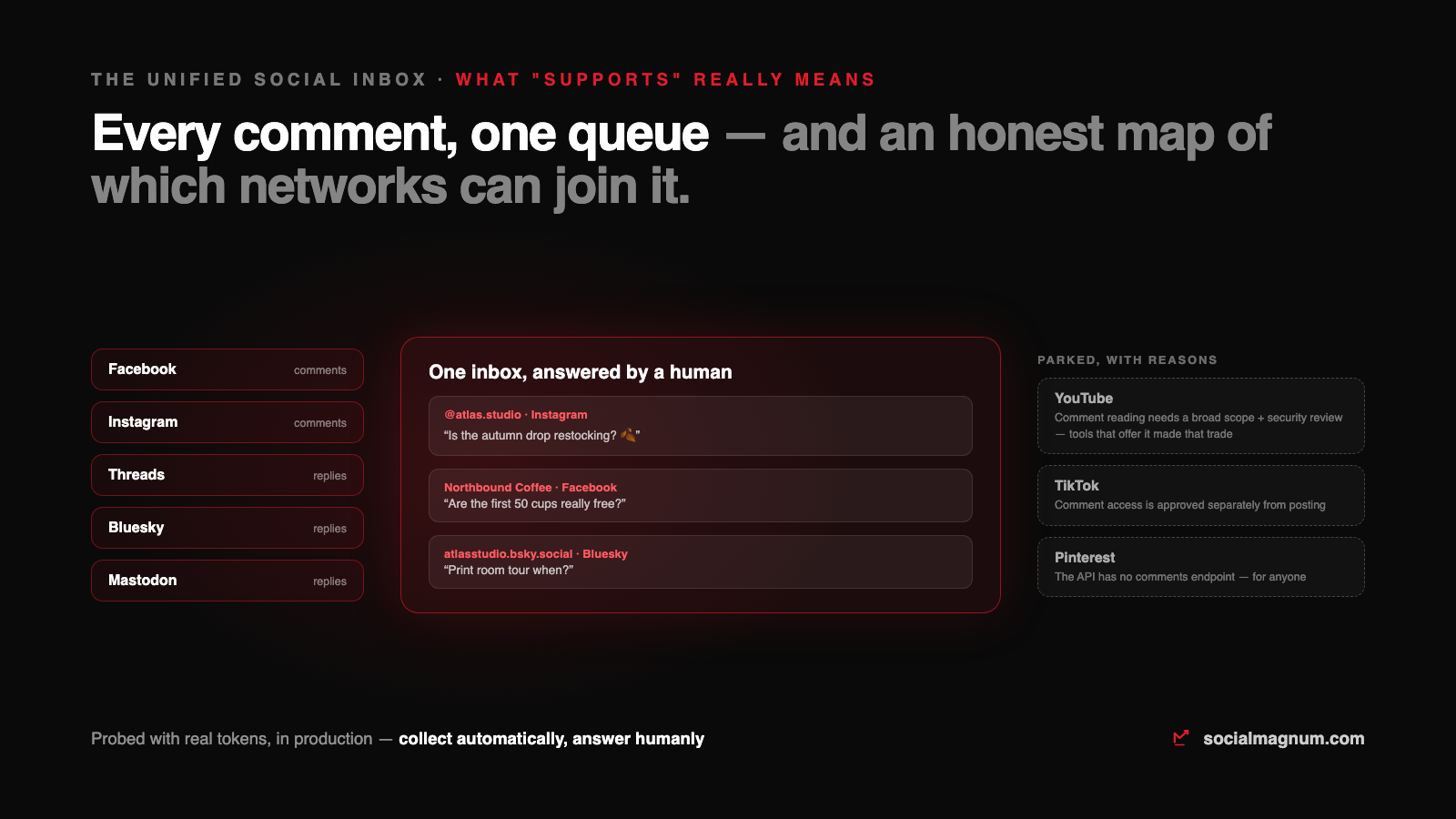
The tax nobody budgets for in social media is not writing posts — it is checking eight apps for replies. A question under a Facebook post, a Bluesky reply, an Instagram comment from your best customer: each lives in its own app, each expects an answer soon, and the checking loop eats an hour a day in ten-minute bites.
A unified inbox collapses that loop into one queue. This is how to run one well — and, because we wired ours against every network’s API with real tokens, an honest map of which networks can actually join it and what the vendor phrase “supports comments” is hiding when it appears on a pricing page.
What a unified social media inbox is
A unified inbox is one queue that collects comments, replies and mentions from all your connected social accounts, lets you answer from the account that was addressed, and tracks what is handled. The collection is automated through each platform’s official API; the answering stays human — that division of labour is the entire design.
Which networks can live in one inbox
| Network | In the queue? | What we found with real tokens |
|---|---|---|
| Yes | Page comments read and answered with standard publishing permissions | |
| Yes | Business-account comments through the same Meta surface | |
| Threads | Yes | Replies are first-class API objects — collected and answered in-thread |
| Bluesky | Yes | Replies and mentions; the app password covers everything |
| Mastodon | Yes | Replies to your posts on public threads |
| YouTube | Gated | Readable only under a broad scope that requires a Google security review — tools offering it made that trade |
| TikTok | Gated | Comment access is a separate approval from posting — posting support tells you nothing about it |
| None | The API has no comments endpoint, for any tool |
The workflow that keeps the queue at zero
- Batch, don’t graze. Two or three fixed sittings a day beat constant notifications — replies within hours, attention in one piece.
- Work statuses, not memory. Open → done, with a tab for each. The inbox is a checklist, not a feed; zero is a state you can reach and see.
- Filter by type when volume spikes. Comments, replies and mentions are different jobs — answering customers first and conversations second is a policy the filters enforce.
- Answer from the queue, land in the thread. A reply sent from the inbox posts from the addressed account and threads correctly on the platform — to the person you answered, nothing differs from a native reply.
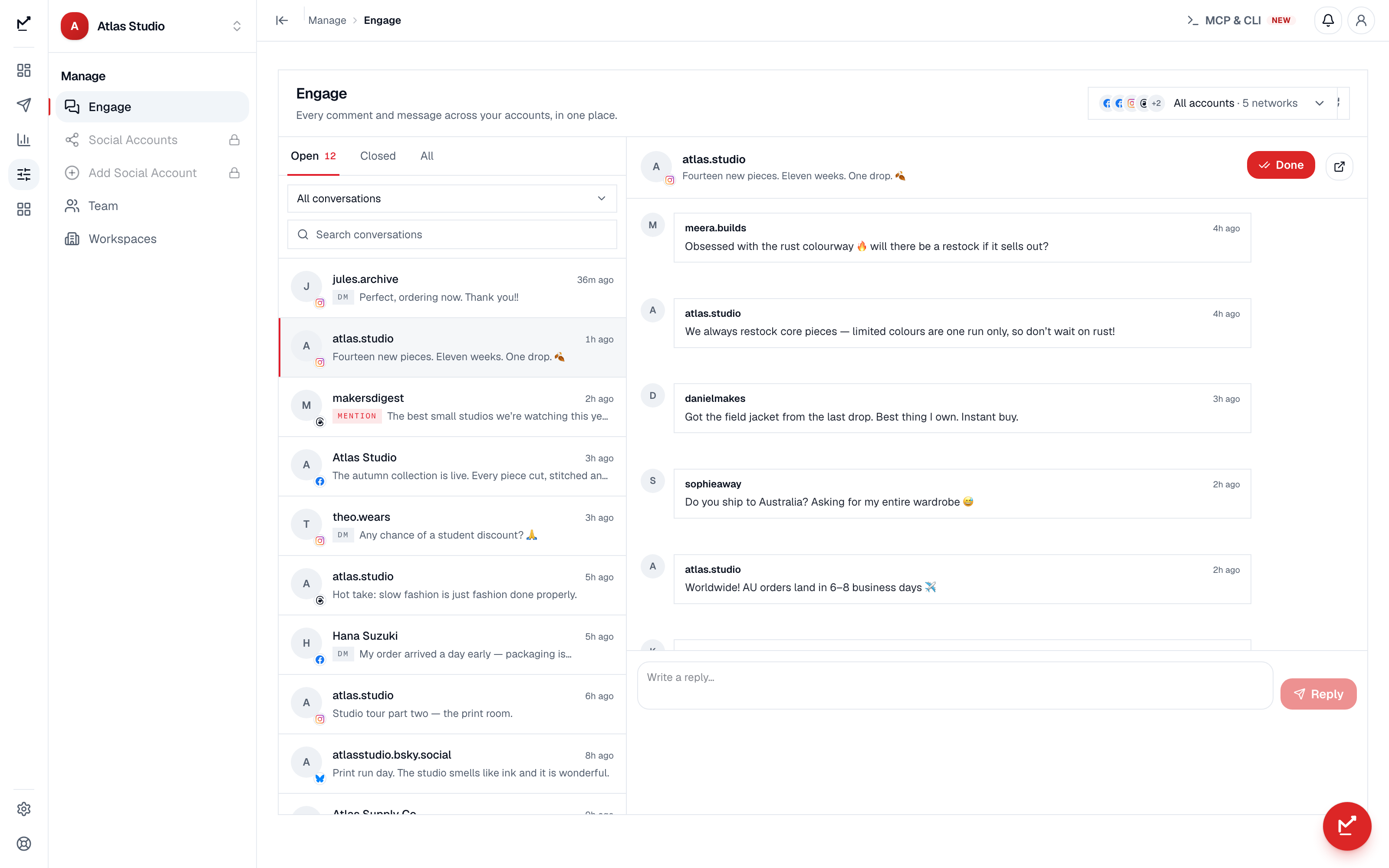
The details that make inbox tooling polite
Two mechanics we sweated that a reader would never think to ask about, and should want in any tool: replies on Mastodon are sent unlisted by default, so a day of support answers never floods an instance’s public timeline — federated culture notices. And replies on Bluesky carry the full thread references, so the conversation stays intact in every client rather than detaching into an orphan post. Good inbox tooling is invisible precisely because it respects each network’s norms.
The automation boundary
Collect automatically; answer humanly. Auto-reply bots sit in the same policy family as the engagement automation that gets accounts restricted on Facebook and Instagram — and readers can smell templated replies anyway. The inbox’s job is to make the human answer cheap, not to fake it.
Working the gaps honestly
For the three networks outside the queue, the native apps remain the desk: YouTube Studio for YouTube comments, the TikTok app for TikTok, Pinterest for Pinterest. Fold them into the same batching rhythm — one extra stop per sitting — and re-evaluate as APIs move. A tool that pretends those tabs don’t exist is optimising your impression of it, not your day.
The short version
- 1
A unified inbox automates the collecting and keeps the answering human — one queue, statuses, replies that land in-thread from the addressed account.
- 2
Five networks can genuinely share one queue today: Facebook, Instagram, Threads, Bluesky and Mastodon.
- 3
'Supported' on a pricing page can mean posting only — always ask whether you can read and answer comments on the specific network and plan.
- 4
YouTube and TikTok comment access sit behind separate approvals (a real trade some tools made); Pinterest has no comments API for anyone.
- 5
Polite tooling respects platform norms — unlisted support replies on Mastodon, intact threading on Bluesky — and never fakes the human part.