How to schedule Threads posts (and what the API really allows)
Threads has a free public API — but no scheduling parameter, which explains how every Threads scheduler actually works. The real quotas, the one-topic-tag culture, and the follower-count bug to expect.
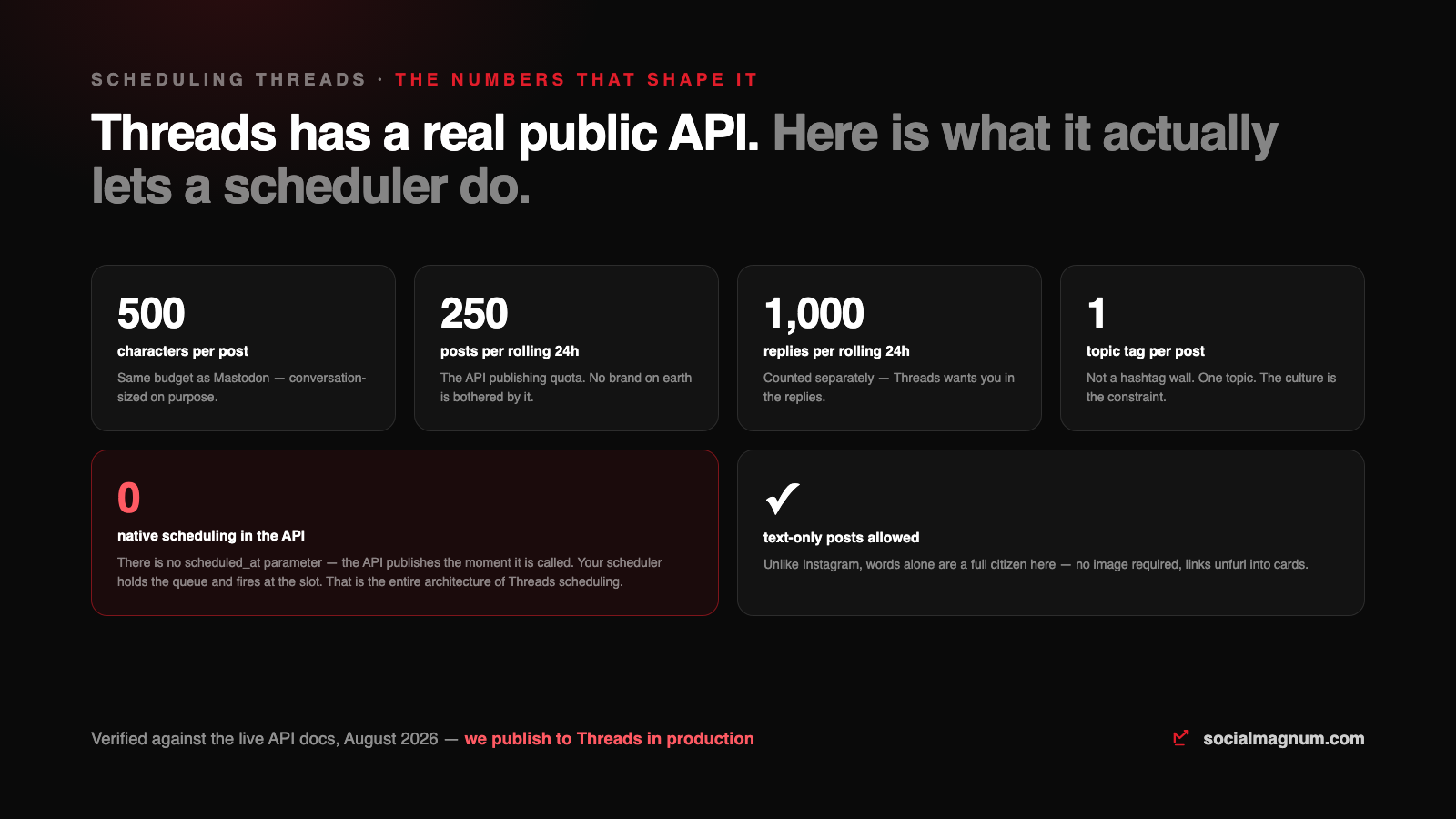
Threads is the youngest network with a real public API, and the content around it shows: half the guides predate the API, and the other half guess. We publish to Threads in production — our app went through Meta’s review for it — so this is the actual state of scheduling Threads posts: what the API permits, the numbers that shape it, and the one architectural fact that explains how every Threads scheduler works.
Can you schedule Threads posts?
Yes. Threads has an official public API that supports publishing text posts, images, carousels and video, plus replies and insights — and scheduling tools use it to publish queued posts at the time you choose. The API itself is free, and unlike Instagram’s, it accepts text-only posts.
The numbers that shape a Threads calendar
| Limit | Value | What it means in practice |
|---|---|---|
| Characters per post | 500 | Conversation-sized on purpose — same budget as Mastodon |
| API posts per rolling 24h | 250 | A quota no brand approaches; bulk importers pace against it |
| API replies per rolling 24h | 1,000 | Counted separately from posts — Threads wants you in the replies |
| Topic tags per post | 1 | Not a hashtag wall; one topic, chosen well |
| Text-only posts | Allowed | Words are a full citizen — no image requirement |
| Media | Images, carousels, video | Links unfurl into preview cards |
The culture is the real constraint
Everything imported from Instagram muscle memory misfires on Threads. The hashtag wall becomes one topic tag — the platform literally accepts a single one. The polished announcement underperforms the open question. And the reply counts for more than the post: Threads distributes conversation, which is presumably why the API’s reply quota is four times its posting quota. Schedule the posts; show up live for the replies.
The scheduling workflow
- 1. Connect Threads directly. Threads authorises through its own login and its own permissions — a proper OAuth screen, no password handed to anyone.
- 2. Write for the 500, not down to it. If you run the write-the-core-first workflow from posting to every network at once, your Threads version is the core plus one question.
- 3. Queue at conversation hours. Threads is a phone-in-hand network; schedule where replies can happen, because the algorithm feeds on them.
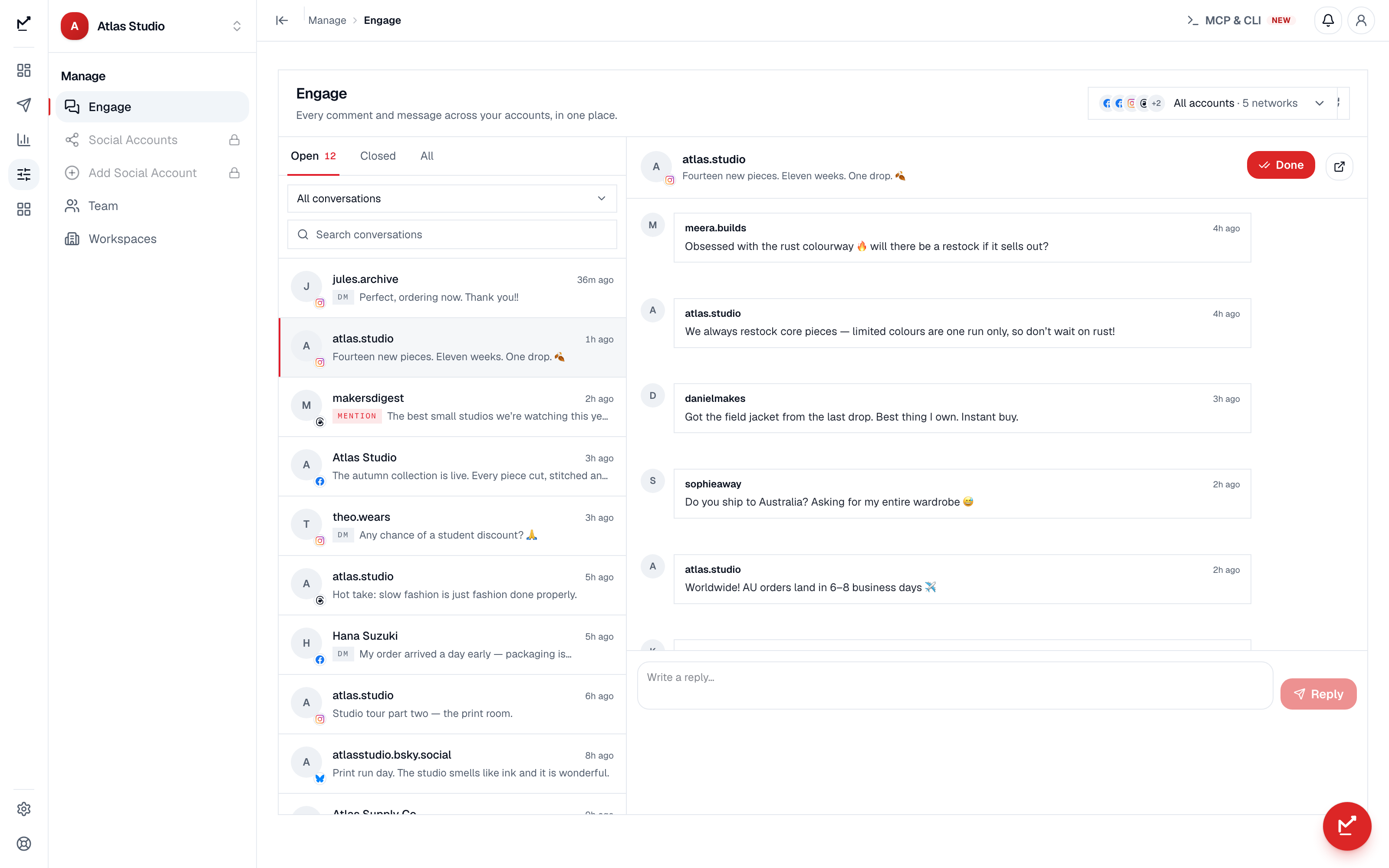
- 4. Route the replies somewhere you’ll see them. Replies are first-class objects in the API, which is why a shared inbox can collect them next to your other networks’ comments.
One honest expectation about Threads analytics
If your scheduler’s dashboard shows a Threads follower count that trails the app — including a flat zero on a new account — that is currently Meta’s bug, not the tool’s: the follower metric is a daily rollup that under-reports small accounts, while other metrics in the same API response return correctly. We documented it, with the receipts, in why your numbers don’t match the native apps.
The mistakes that waste the head start
- Treating it as an Instagram caption mirror. Same company, opposite culture — text-first, one tag, question-shaped.
- Link-dumping every post. Links are allowed and unfurl fine, but a feed of pure link posts reads as syndication, and syndication earns no replies.
- Scheduling the posts and ghosting the replies. On the network whose API gives you 4× the quota for replying, silence is the expensive part.
- Waiting for it to feel established. The reason to build a Threads habit now is precisely that most brands haven’t — the feed has room, and early consistency compounds.
The short version
- 1
Threads scheduling is real and official: a free public API supports text, images, carousels, video, replies and insights — text-only posts included.
- 2
The API has no scheduled_at — every Threads scheduler holds the queue itself and publishes at the slot. Choose tools by queue reliability, not claimed API magic.
- 3
The quotas tell the strategy: 250 posts but 1,000 replies per day — schedule the posts, be human in the replies.
- 4
One topic tag, 500 characters, questions over announcements — Instagram habits are the main thing to unlearn.
- 5
A lagging Threads follower count is currently Meta's rollup bug, not your scheduler — judge tools by what they publish, not that number.