Do hashtags still work in 2026?
Instagram now caps hashtags at five, Threads allows exactly one, and Mastodon still runs on them. The hashtag isn't dead — it gets paid differently on every platform. The per-network truth and the ladder strategy that survives everywhere.
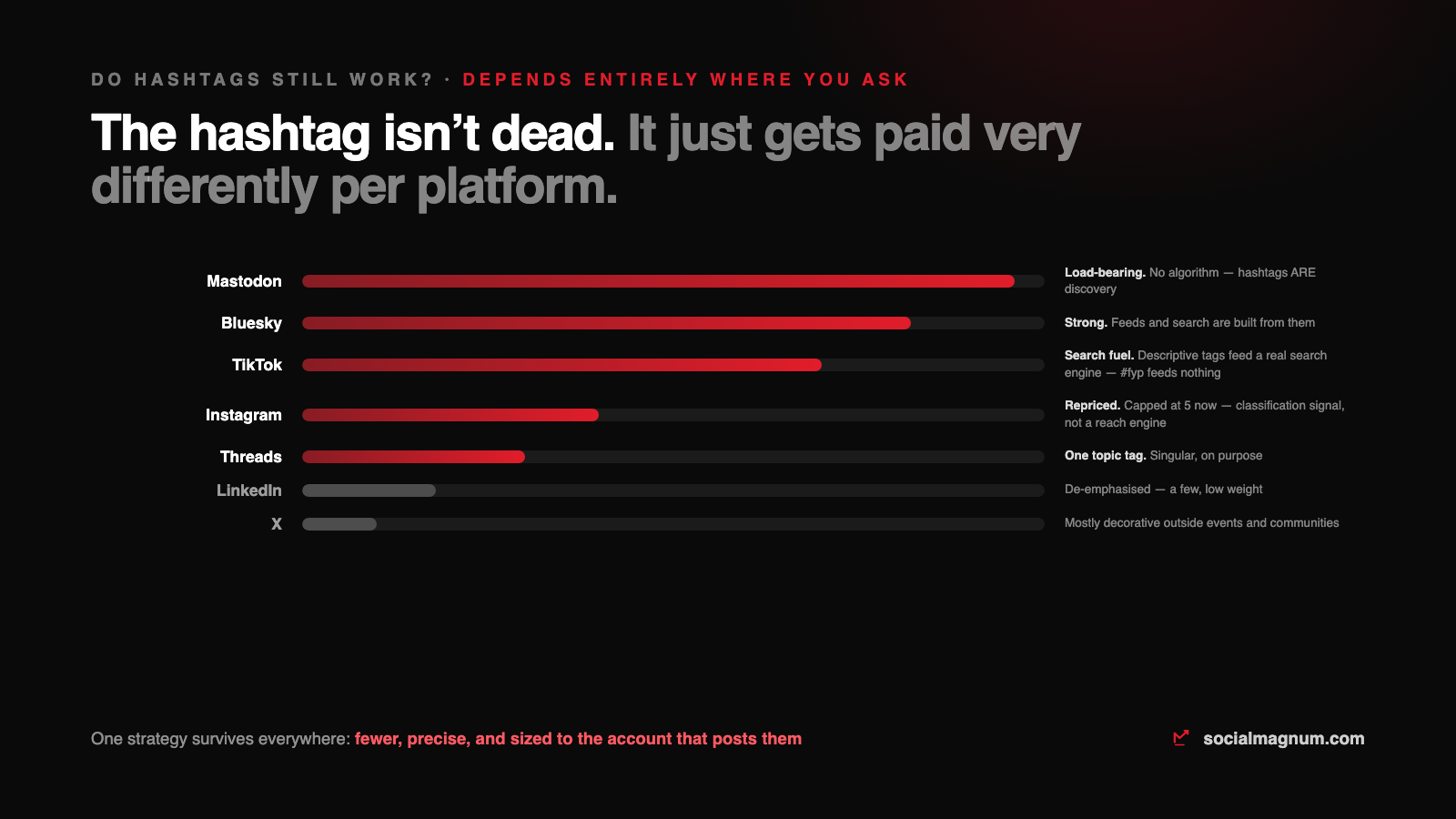
The 30-hashtag block under an Instagram post is now a period piece — Instagram literally will not accept it anymore. Which makes the annual question sharper than usual: do hashtags still do anything in 2026, or are we decorating?
The honest answer is that “the hashtag” stopped being one thing. On some networks it is the entire discovery system; on others it has been repriced into a small classification hint. Treating every platform’s tags the same is the actual mistake — so here is the per-platform truth, and the one strategy that survives everywhere.
What hashtags do now
A hashtag in 2026 is metadata with two jobs: it files your post into a topic so the algorithm knows who to test it on, and it makes the post findable in search and topic feeds. What it no longer does — anywhere — is function as a reach cheat code, where volume of tags translated into volume of eyeballs. The follow-a-hashtag era is over; the describe-your-content era is what remains.
Where hashtags still earn, network by network
| Network | How many | What tags do there |
|---|---|---|
| Mastodon | 2–4 | Load-bearing: there is no algorithm — hashtags and follows ARE discovery |
| Bluesky | 2–3 | Strong: custom feeds and search are built from them |
| TikTok | 3–5, descriptive | Search fuel for a platform people genuinely search — #fyp feeds nothing |
| Up to the 5-tag cap, precise | Classification signal; the data favours using all 5 slots well | |
| Threads | Exactly 1 topic tag | Singular by design — pick the one true topic |
| 0–3 | De-emphasised; low weight either way | |
| X | 0–1 | Mostly decorative outside live events and communities |
TikTok: hashtags as search terms
TikTok is the one large network where tags still connect directly to discovery — because TikTok functions as a search engine for a generation of users, and tags are indexed search surface. The implication writes the strategy: tag what the video literally is (#sourdoughstarter, not #foodie), because you are writing search queries, not waving at an algorithm. Generic momentum tags like #fyp are the emptiest calories on the platform — TikTok has said as much itself.
The fediverse: where tags never stopped working
Mastodon has no recommendation algorithm at all — reach happens through follows, boosts and hashtags, full stop. Tags there are not garnish; they are the road. Bluesky sits nearby: its custom feeds and search consume tags, so a well-chosen one puts you in front of exactly the community that built a feed around it. And Threads allows precisely one topic tag — a design choice that tells you what Meta learned from Instagram’s hashtag walls.
The ladder: the strategy that survives every platform
Wherever tags matter, the same physics applies: a tag with millions of posts buries you in seconds, and a tag with forty posts has no readers. The strategy is a ladder — a mix of sizes matched to the account posting them:
- One or two broad tags for the category — reach lottery tickets with honest odds.
- Mostly mid-size tags — big enough to have an audience, small enough that your post can hold a top spot for hours. This is where accounts actually rank.
- One or two niche tags where your post will sit at the top for days for whoever searches them.
“Sized to the account” is the part everyone skips: a 200-follower account cannot win a million-post tag, and a 100k-follower account is wasting slots on tiny ones. Our free hashtag generator is built on exactly this ladder — pick a niche, tell it your follower range, and it hands back the balanced set rather than thirty copies of #love.
The habits to unlearn
- The same tag block on every post. Repetitive identical metadata reads as spam signal and stops matching content the moment your content varies.
- Generic emotion tags. #love has hundreds of millions of posts and describes nothing. If a tag could sit under any photo ever taken, it files nothing.
- One tag strategy for eight platforms. The same block that is correct on Mastodon is a third over Instagram’s cap and four tags too many for Threads — per-network furniture applies to tags first.
- Tagging the aspiration, not the content. Tags are classification. The algorithm tests your post on the tag’s audience — mislabel the box and the wrong people open it, engagement reads cold, and distribution stops.
The short version
- 1
Hashtags in 2026 are metadata, not magic: they classify posts and feed search, and their value ranges from load-bearing (Mastodon, Bluesky, TikTok search) to decorative (X).
- 2
Instagram now caps hashtags at five — and the data since favours using all five slots with precise tags.
- 3
On TikTok, write tags as search queries: what the video literally is, never #fyp.
- 4
The ladder survives everywhere tags matter: a couple of broad tags, mostly mid-size ones you can rank in, one or two niche — sized to your follower count.
- 5
Per-network tag culture is real: one topic tag on Threads, a handful on the fediverse, five on Instagram. One block for all platforms is the tell of a tool blasting.