The One-Page Social Media Strategy Template (2026)
Strategies fail as decks nobody reopens. This one is seven blocks on one page — objective, audience, pillars, networks, mix, KPIs, review loop — with the prompts to fill each and a worked example.
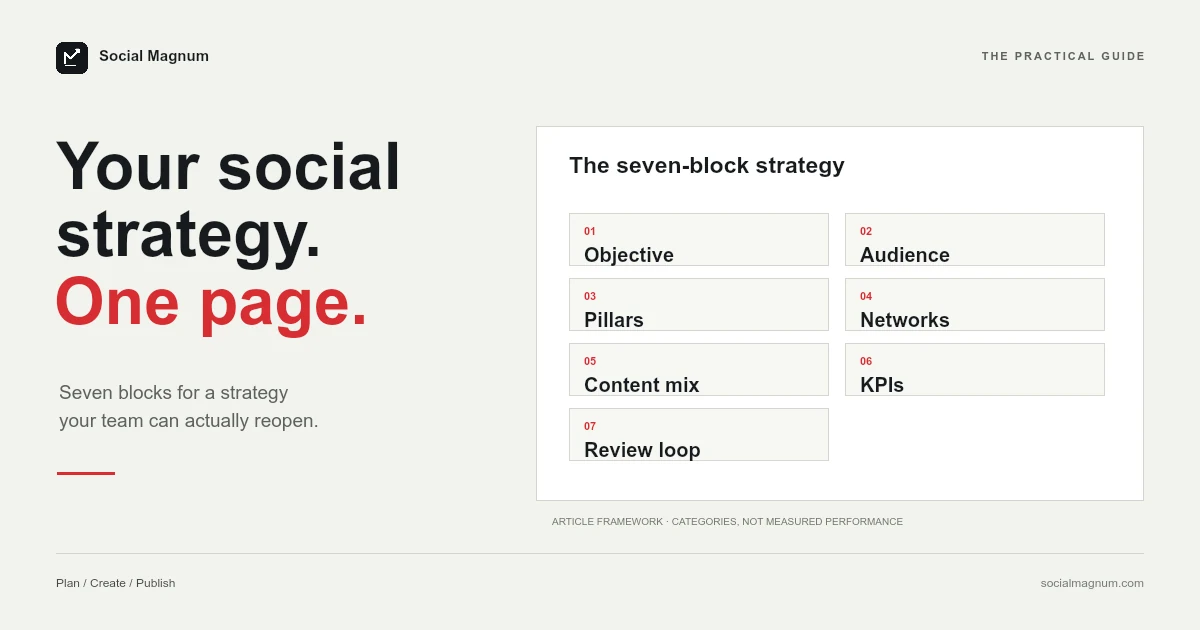
Most social media strategies are decks nobody reopens. A working strategy is one page with seven blocks, each answering a question in a sentence or a short list — precise enough to decide next week’s posts, short enough to actually get consulted. This page is that template: the seven prompts, what a strong answer looks like, and a filled-in example to copy against.
Why one page beats a deck
Strategy fails at the moment of use: Tuesday, 4pm, deciding what to post. A forty-slide deck is unopenable at that moment; one page is glanceable. The test for every block below is the same — does this line change what gets posted next week? If an element cannot pass that test (brand essence wheels, persona collages), it does not belong on the page.
Block 1 · Objective: one sentence, one business outcome
The prompt: “Social media exists for us to ______, measured by ______.” One outcome, not four. “Generate enquiries from local homeowners, measured by DM and form leads per month” decides things; “build brand awareness and community engagement” decides nothing. Every later block inherits its spine from this sentence.
Block 2 · Audience: one person, described specifically
The prompt: who exactly is the follower who becomes a customer — their situation, the problem that brings them to you, what they scroll for at 9pm. Specific beats demographic: “first-time renovators overwhelmed by trade quotes” writes captions for you; “adults 25 to 54” writes nothing. A secondary audience is allowed one line; a third is a different strategy.
Block 3 · Content pillars: two or three, no more
The prompt: the two or three repeatable themes that serve the objective — typically one that teaches (earning saves and search), one that shows the work (earning trust), one that entertains inside the niche (earning shares). Pillars are the promise your account makes; our 48 post ideas organised by job exist to refill exactly these.
Block 4 · Networks and cadence: each with a stated job
The prompt: a short table — network, its job, its cadence. A network without a job you can phrase in five words is a network to drop; a cadence you cannot hold on your worst week is a plan to break. Two networks done properly beat five done sporadically.
Block 5 · Content mix: a ratio you can audit
The prompt: of every five posts — how many teach, how many show, how many entertain, how many sell? A workable default is 2 : 1 : 1 : 1 with selling capped at one; the folk 80/20 and 5:3:2 rules encode the same guardrail. The ratio earns its place because it is auditable: look at the last twenty posts on the calendar and the drift is visible immediately.
Block 6 · KPIs: three to five, with a review rhythm
The prompt: pick one reach metric, one or two engagement metrics, one conversion metric and one operations metric — each benchmarked against your own trailing three-month average, reviewed monthly. Our 12-KPI guide with formulas is the menu; the strategy page holds only your chosen few.
Block 7 · The review loop: the block everyone skips
The prompt: when do you look at the numbers, and what are you allowed to change? A sane loop: monthly, fifteen minutes — what overperformed, what flopped, one adjustment to pillars, mix or cadence. One change per month keeps the strategy stable enough to measure; a strategy rewritten weekly is just mood.
The template, filled in
A worked example for a two-person bakery, copyable structure intact:
| Block | Their answer |
|---|---|
| Objective | Fill weekday pre-orders, measured by order-link clicks and DMs per week |
| Audience | Office workers within 3km deciding tomorrow's lunch the night before |
| Pillars | Behind the counter (trust) · What's fresh tomorrow (sell) · Bread science in 30s (teach) |
| Networks | Instagram: main stage, 4 posts + daily story · TikTok: reach engine, 3 videos · Facebook: local groups, 2 reposts |
| Mix per 5 posts | 2 teach · 1 show · 1 entertain · 1 sell (the what's-fresh post) |
| KPIs | Non-follower reach % · saves per post · order-link CTR · posting consistency |
| Review loop | First Monday monthly, 15 minutes, one change maximum |
From here the workflow is mechanical: the strategy fills the content calendar, the calendar gets batched and queued — Social Magnum is ours, one calendar across 20+ networks with a free plan, and the template works identically in any tool — and the review loop closes the circle monthly.
The short version
- 1
One page, seven blocks, one hour to fill — a strategy you consult beats a deck you present.
- 2
Every block must change what gets posted next week, or it gets cut.
- 3
One objective, one primary audience, two or three pillars: the discipline is subtraction.
- 4
Networks each get a five-word job and a worst-week cadence.
- 5
Review monthly, change one thing — stability is what makes the numbers readable.
Related reading: the content calendar template, the 12 KPIs that matter and 48 post ideas by what they earn.