48 Social Media Post Ideas for 2026 (By What They Earn)
Idea lists fail when they are fifty random prompts. These 48 are organised by what each earns — saves, shares, comments, trust, sales, or your time back — so you can pick for the slot you need to fill.
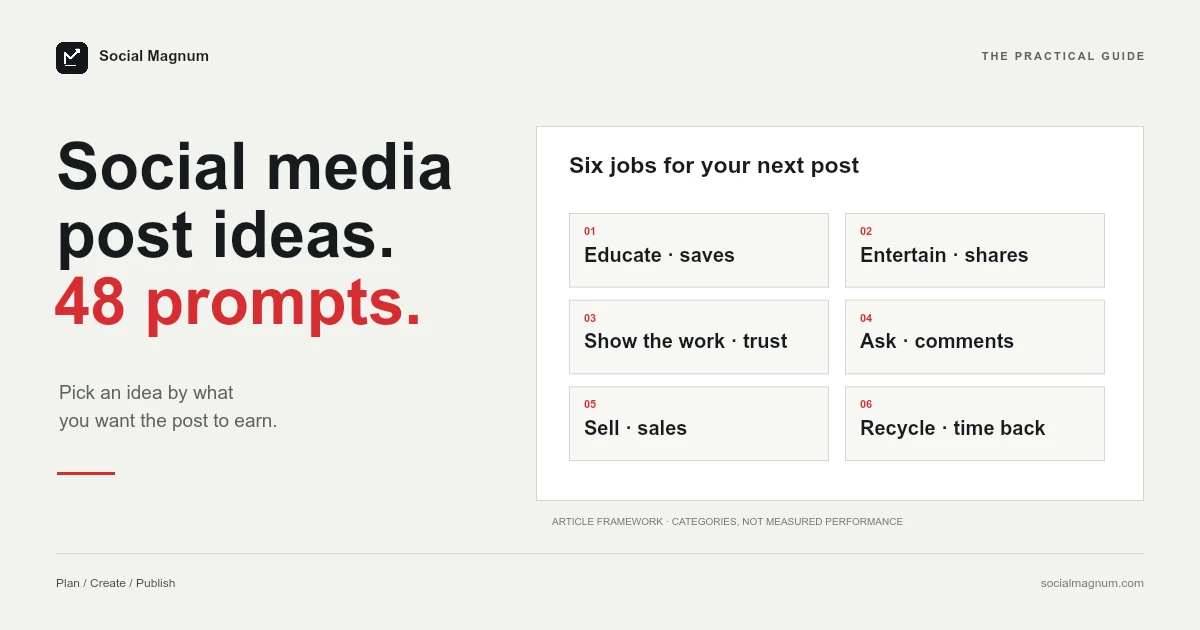
Idea lists usually fail the same way: fifty random prompts, no reason behind any of them, nothing you can reuse next month. This list is organised by what each idea earns — saves, shares, comments, trust, sales, or your time back — because that is how you pick the right one for the slot you are trying to fill. Every idea works on Instagram, TikTok, Facebook and the rest with format adjustments; none require a big audience to start working.
Educate: earn saves (ideas 1–8)
- 1 · The three-mistakes post. The errors beginners in your niche make, and the fix for each.
- 2 · The mini tutorial. One narrow skill, start to finish, in under a minute of video or one carousel.
- 3 · The checklist. Everything to check before X — printable, save-able, forwardable.
- 4 · Myth vs fact. The thing everyone in your niche believes that is wrong, with your evidence.
- 5 · The glossary post. Five terms your customers pretend to understand, explained plainly.
- 6 · Before you buy. What to look for when choosing a product or service like yours — honest enough to include when not to buy.
- 7 · The tool stack. What you actually use to do the work, and why each earns its place.
- 8 · The one-number post. A single surprising, verifiable fact from your field, explained in context.
Entertain: earn shares (ideas 9–16)
- 9 · The hyper-specific relatable. “POV: the client says it should be quick” — the more niche, the more it gets sent.
- 10 · The trend with your twist. The trending sound or format, applied strictly to your subject.
- 11 · Expectation vs reality. The brochure version of your work next to the true version.
- 12 · The gentle rant. The pet peeve your whole industry shares, said out loud once.
- 13 · Day one vs now. Your first attempt beside your current work — self-deprecation travels.
- 14 · The niche meme. A format everyone knows, captioned for your trade only.
- 15 · Things customers say. Real (anonymised) quotes, performed deadpan.
- 16 · The unexpected crossover. Explain your craft through something unrelated — cooking through football, tax through dating.
Show the work: earn trust (ideas 17–24)
- 17 · The time-lapse. The whole job compressed to thirty seconds — the internet never tires of these.
- 18 · Behind the decision. Why you chose this material, price, name or design — reasoning is content.
- 19 · The workspace tour. Where the work happens, mess included.
- 20 · A real project, start to finish. Brief, obstacles, result — a case study without the corporate voice.
- 21 · The mistake we made. What went wrong recently and what changed because of it — the highest-trust post there is.
- 22 · Meet the team. One person, one specialty, one strong opinion about the craft.
- 23 · The packaging or prep ritual. Orders being packed, mise en place, the pre-flight checklist — process ASMR.
- 24 · The numbers post. Something honest and concrete: orders shipped this month, hours a piece takes, revisions a design goes through.
Ask: earn comments (ideas 25–32)
- 25 · This or that. Two options from your niche, no fence-sitting allowed.
- 26 · The unpopular-opinion prompt. Ask for theirs about your industry; pin the spiciest.
- 27 · Fill the blank. “The most overrated ___ in [niche] is…”
- 28 · The settle-the-debate post. The argument your customers already have, put to a vote.
- 29 · Ask for the story. “Tell me your worst [niche] experience” — replies become future content.
- 30 · The recommendation thread. Ask for their favourite tool, spot or resource; compile the answers into idea 3’s checklist later.
- 31 · Caption this. A genuinely odd photo from your work week.
- 32 · The would-you post. A real trade-off from your field — cheaper but slower, prettier but fragile — and let them choose.
Sell softly: earn sales (ideas 33–40)
- 33 · The transformation. Before and after, with the customer’s words doing the selling.
- 34 · The FAQ answer. The question every buyer asks, answered once on camera, reused forever.
- 35 · Who this is not for. Naming the wrong-fit customer sells the right-fit harder than any pitch.
- 36 · The objection post. “Too expensive compared to what?” — take the objection seriously and answer it.
- 37 · How to get the most from it. Care tips, power-user tricks, setup done right — value for buyers, proof for browsers.
- 38 · The origin of one product. Why this thing exists, what problem birthed it.
- 39 · The quiet restock or availability post. Plain, factual, twice a month at most.
- 40 · The customer spotlight. Their project, their words, your product in a supporting role.
Recycle: earn time back (ideas 41–48)
- 41 · The greatest-hit rerun. Repost your best performer from 90+ days ago; most followers never saw it.
- 42 · The format flip. Turn a carousel into a talking video, a video into a checklist, a thread into a graphic.
- 43 · The update post. “Six months ago I said X — here is what actually happened.”
- 44 · The compilation. Your five best tips from past posts, stitched into one.
- 45 · Answer a real comment. One good question from your inbox becomes the next post — with permission where it matters.
- 46 · The seasonal rerun. Last year’s holiday or season post, refreshed, on schedule.
- 47 · The cross-network port. The TikTok that worked, exported clean and re-cut for Reels and Shorts.
- 48 · The archive dig. Your first-ever post, revisited — part reflection, part idea 13.
Turn ideas into a system
Forty-eight ideas are useless the moment the notebook closes. The system is smaller than it sounds: pick one idea per job for next week — one educate, one entertain, one process, one ask, at most one sell — drop them into a content calendar, batch the writing and filming in one sitting, and queue the week in a scheduler. (Social Magnum is ours — 20+ networks from one calendar with a free plan — and the rotation works identically in any tool.) Hashtags and captions come easier with the idea’s job already decided; our free hashtag generator covers the last step.
The short version
- 1
Pick ideas by the job the slot needs — saves, shares, comments, trust, sales or time — not by novelty.
- 2
Rotate the six jobs weekly; sell at most once per rotation.
- 3
Every strong post can be flipped into two more formats (idea 42) — plan the flip when you plan the post.
- 4
Replies and questions are a renewable idea source (ideas 29, 30, 45).
- 5
Ideas become growth only on a cadence: calendar, batch, queue.
Related reading: the content calendar template, how to get more followers on Instagram and how to go viral on TikTok.