How to Go Viral on TikTok in 2026 (The Honest Version)
Nobody can promise a viral TikTok. What you can do is understand how the test-audience system works and stack the odds: hooks, watch time, trends with a twist, and enough volume for the math to land.
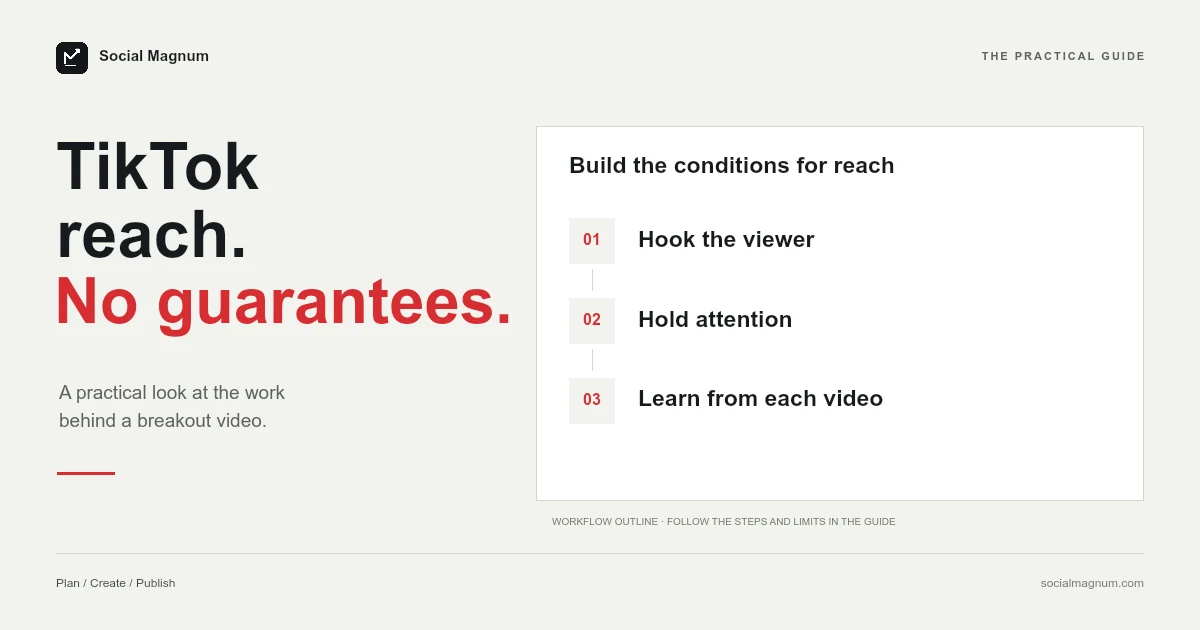
Nobody can promise you a viral TikTok — anyone who does is selling a course. What you can do is understand how distribution works and stack the odds until virality stops being luck and starts being a rate: post enough well-built videos and some percentage of them outperform, occasionally spectacularly. This guide is that odds-stacking, without the mythology.
How TikTok actually distributes
Every upload gets shown to a test batch of viewers, most of whom do not follow you. TikTok watches what they do: finish it, rewatch it, share it, comment, tap your profile — or swipe away. Strong signals widen the audience; the cycle repeats in waves, which is why videos can surge hours or even days after posting. Three practical consequences:
- Every video gets a chance. Follower count matters less than on any other platform — the test batch is offered to accounts of every size.
- The video is judged, not the account. One weak video does not doom the next; one strong one does not guarantee it either.
- Completion is the currency. A 9-second video people watch twice beats a 90-second video they abandon at 20%.
1 · The first second is the video
Viewers decide in roughly a second whether to stay. Everything before your point is tax. The hooks that keep working share one property — they open a loop the viewer needs closed:
- Start mid-action. The pour, the reveal half-done, the mistake already happening. Context comes second, if at all.
- Say the stakes out loud. “This cost me my biggest client” · “Nobody tells beginners this” — a claim that demands the rest.
- On-screen text as a second hook. Many watch muted first; the text line must work alone.
- Cut “hey guys”. Introductions, logos and channel branding are where completion rates go to die.
2 · Engineer watch time, honestly
- Make it exactly as long as it earns. Trim every second that does not move the video forward. Short and finished beats long and abandoned; longer videos win only when they genuinely hold.
- Cut every two to four seconds. Angle changes, zooms and text changes reset attention without changing content.
- Close the loop at the end — or do not. Payoffs earn completion; seamless loops earn rewatches. Both count.
- Reply-bait honestly. A genuine open question or a mildly contested take earns comments; rage-bait earns reports.
Keep the file clean: vertical 9:16, no other platform’s watermark. Our free browser video editor crops and trims without adding one, and our guide to TikTok video sizes has the exact dimensions.
3 · Ride sounds and trends — with your twist
Trending sounds and formats are distribution trains already moving: using one attaches your video to an audience actively browsing it. The rule that separates growth from noise is the twist — the trend applied to your niche, not copied straight. A plumber doing the trending format about plumbing recruits followers who care about plumbing; a plumber lip-syncing recruits nobody. Catch trends early (the browse page, the sounds your niche’s creators reuse), because trains empty after the peak.
4 · Volume is the strategy, not a tip
Because every video is its own lottery ticket with skill-weighted odds, the single biggest lever is the number of good tickets. One video a week gives the algorithm almost nothing to test; one a day for two months teaches you more about your audience than a year of theorising. The workable pattern for most creators is batching — film several in one session, then release them on a schedule rather than dumping them the same afternoon.
That release rhythm is scheduler work. Social Magnum is ours — it queues TikTok alongside seven other networks, with a free plan and editing allowed right up to publish time — and the batching advice holds with any tool. Posting when your audience is actually scrolling adds a real margin; our measured guide to the best times to post on TikTok covers it without the fake heat-map charts.
5 · Make parts, not posts
The accounts that convert one viral moment into a lasting audience think in series: Part 2 pinned under Part 1, a repeatable format viewers recognise (“rating my clients’ kitchens, week 14”), a storyline people follow to its end. Series convert viewers into followers because following becomes the way to see what happens next — a single great video, on its own, mostly earns applause from people you never see again.
6 · What to do when one takes off
- Answer the comments while it burns. Early conversation feeds the wave; pinned replies steer it.
- Reply with video. Comment-reply videos inherit the original’s momentum — the cheapest sequel you will ever make.
- Ship the follow-up within a day or two. Profile visitors decide whether to follow based on what is next to the hit.
- Do not delete slow videos. Old uploads resurface; deletion only destroys tickets that were still in the draw.
What kills reach
- Watermarked reposts from other platforms — deprioritised, and they look lazy anyway.
- Engagement bait (“like if…”, follow-for-follow threads) — hollow signals the system discounts.
- Buying views or followers — poisons the test batches your next videos rely on.
- Deleting and reposting the same clip repeatedly — duplicate content without the fresh-video benefit.
The honest playbook
The short version
- 1
Virality is a rate, not an event: many well-built videos, each with a real hook, each finished by viewers.
- 2
Spend your effort in order: first second, then watch time, then trend-with-a-twist.
- 3
Post on a sustained schedule — volume is what lets the odds work, batching is what makes volume survivable.
- 4
Think in series so a hit converts into followers instead of applause.
- 5
When one takes off: reply fast, reply with video, ship the sequel — and never buy the numbers.
Related reading: the best times to post on TikTok, how to schedule TikTok posts and how to go viral on Instagram.